坠
Character Story & Explanation
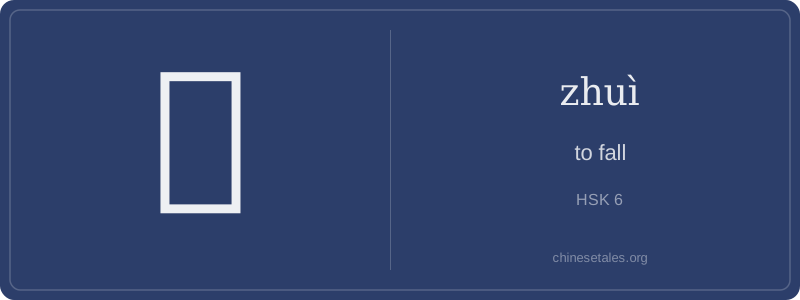
The earliest form of 坠 appears in bronze inscriptions as a combination of 土 (earth/ground) at the bottom and a simplified pictograph of a falling object — possibly a stone or broken vessel — above it, rendered with slanting strokes suggesting downward momentum. Over time, the upper part evolved into the modern ‘队’ (duì) component (originally meaning ‘line of troops marching downward’, reinforcing directionality), while the radical 土 remained anchored below, visually grounding the fall — literally showing something coming *to the earth*.
This visual logic held firm across millennia: in Han dynasty texts, 坠 described meteorites falling from heaven (‘stars坠’), and by the Tang, poets like Li Bai used 坠 to evoke emotional collapse (‘愁肠日百坠’ — ‘sorrow coils and falls a hundred times daily’). The character never strayed from its core idea: uncontrolled, consequential descent ending at the ground. Its structure — earth below, motion above — remains a perfect semantic blueprint: what goes down must land.
Imagine a sudden, heavy silence as a porcelain vase slips from your hand — not just dropping, but *plummeting* with unstoppable force, shattering on the floor. That visceral, irreversible downward motion is 坠 (zhuì): it’s not gentle falling like 飘 (piāo) or routine descent like 下 (xià), but a dramatic, often catastrophic collapse — think aircraft坠毁, stock markets 坠落, or hopes 坠入深渊. It carries weight, finality, and loss of control.
Grammatically, 坠 is almost always a verb — but unlike most verbs, it rarely stands alone. You’ll see it in compound verbs (坠毁, 坠落, 坠入) or passive constructions (被坠落 is incorrect; instead: 被击中后坠毁). Crucially, it’s never used for people ‘falling’ in daily contexts — you don’t say 我坠了一跤 (that’s 摔); 坠 implies gravity + consequence. Learners often overuse it trying to sound literary, but native speakers reserve it for high-stakes, vertical, often tragic descents.
Culturally, 坠 echoes classical gravity metaphors: in the Classic of Poetry, stars 坠 symbolized dynastic collapse; today, media use 坠 to dramatize political scandals or economic crashes — it’s the linguistic equivalent of slow-motion footage. A common mistake? Confusing it with 堕 (duò), which means ‘to degenerate morally’ — 坠 is physical, literal, and unstoppable; 堕 is ethical, gradual, and internal.