堕
Character Story & Explanation
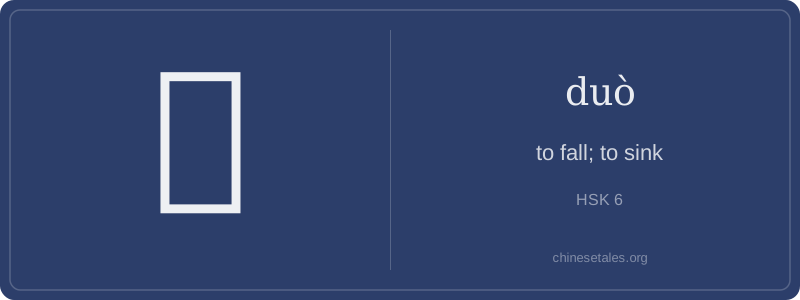
The earliest form of 堕 appears in Warring States bamboo texts as a compound pictograph: on top, a simplified 'person' (亻) or 'head' (), beneath which hangs a heavy, curved stroke representing something falling — possibly a rope or a body — plunging toward 土 (earth). Over centuries, the upper part evolved from into 隋 (suí), a phonetic component borrowed for its sound, while the lower 土 remained firmly rooted. By the Han dynasty, the structure solidified into today’s 11-stroke form: 隋 + 土 — not 'Sui dynasty' + 'earth', but a visual metaphor: *a thing descending under its own weight into the ground.*
This descent wasn’t just physical. In the *Zuo Zhuan*, 堕 was used to describe the deliberate dismantling of city walls ('to pull down, demolish'), linking collapse with human agency. Later, Buddhist texts adopted it for spiritual decline — 'sinking into delusion'. The character’s enduring power lies in this duality: it’s both gravitational inevitability (a stone dropping) and moral consequence (a soul sinking). Its shape — a heavy upper element literally pressing down onto 土 — makes the meaning unforgettable once you see it.
Imagine a heavy stone dropping into soft earth — that’s the visceral feeling of 堕 (duò). Unlike generic 'fall' verbs like 掉 (diào) or 落 (luò), 堕 carries gravity, inevitability, and often moral or physical collapse: things don’t just fall — they *plummet*, *sink*, *crumble*. It’s rarely used for casual dropping (you wouldn’t say 堕手机 to mean 'drop your phone'); instead, it appears in literary, historical, or solemn contexts — think collapsing dynasties, sinking ships, or moral decline.
Grammatically, 堕 is almost always transitive and formal. You’ll see it in classical constructions like 堕马 (duò mǎ, 'to fall from a horse') or modern compound verbs like 堕入 (duò rù, 'to sink into' — e.g., 堕入深渊 'sink into an abyss'). It’s never used as a standalone verb in spoken Mandarin without a complement or object — saying *'他堕了' sounds incomplete and archaic. Learners often overuse it thinking it’s a neutral synonym for 'fall', but native speakers reserve it for weighty, irreversible descent.
Culturally, 堕 echoes Confucian anxieties about moral erosion — 堕落 (duòluò, 'degeneration') is one of the most charged words in Chinese political and ethical discourse. Interestingly, its radical 土 (earth/soil) isn’t just decorative: it visually grounds the falling action — the 'fall' isn't abstract; it's *into the earth*, implying finality, burial, or entrapment. A common mistake? Confusing it with 惰 (duò, 'laziness') — same sound, same tone, but completely different meaning and origin. Don’t let your diligence *堕* into laziness!