坛
Character Story & Explanation
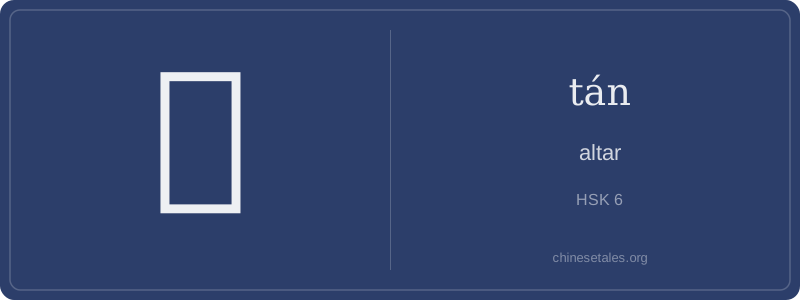
The earliest form of 坛 appears in bronze inscriptions as a simple pictograph: a raised square platform (□) atop a base of packed earth (土). Over time, the top evolved into the ‘Y’-shaped component (亶) — originally depicting a ceremonial vessel or grain offering — while the radical 土 remained firmly at the bottom, anchoring the character in the earthly realm. By the seal script era, the shape had stabilized into the seven-stroke structure we know: 土 (earth) supporting 亶 (ritual integrity), visually echoing how ancient altars were literally mounds of tamped soil crowned with offerings.
This visual logic shaped its semantic journey: from concrete ritual platforms (like the Ming-era Temple of Heaven’s circular Heaven Altar) to abstract spheres of influence. In classical texts like the Rites of Zhou, 坛 specified exact dimensions and orientations for state sacrifices—showing how geometry itself was sacred. Later, scholars extended it metaphorically: 文坛 (wéntán) emerged during the Song dynasty to describe the ‘elevated field’ where literary masters competed and conferred legitimacy—proving that in Chinese thought, authority doesn’t float in the air; it stands on solid, designated ground.
At its heart, 坛 (tán) isn’t just a physical altar—it’s a conceptual platform: elevated, intentional, and charged with ritual gravity. In Chinese thought, sacred space isn’t defined by grandeur but by *designation*: a simple earthen mound becomes a nexus between heaven and earth when ritually consecrated. That’s why 坛 carries an air of solemn authority—not passive furniture, but an active stage for cosmic dialogue.
Grammatically, 坛 is almost always a noun, but it’s rarely used alone. It appears in compound nouns (like 天坛 or 文坛) and often functions as a classifier-like suffix for domains of influence—think ‘the arena of literature’ rather than ‘a literary altar’. Learners mistakenly treat it like English ‘altar’ and try to say *‘I built an altar’* with standalone 坛; but native speakers say 我建了一个祭坛 (wǒ jiàn le yí gè jìtán)—the word nearly always needs a modifier (祭, 天, 文, etc.) or appears in fixed compounds.
Culturally, 坛 reveals how deeply Chinese tradition embeds hierarchy and ritual into spatial language: even modern terms like 论坛 (lùntán, ‘forum’) borrow the sense of a formally sanctioned space for authoritative discourse—not just any discussion, but one with gravitas, structure, and implied consensus. A common error? Confusing it with 潭 (tán, ‘deep pool’), which sounds identical but evokes still water, not sacred ground—mixing them turns ‘academic forum’ into ‘academic pond’!