壤
Character Story & Explanation
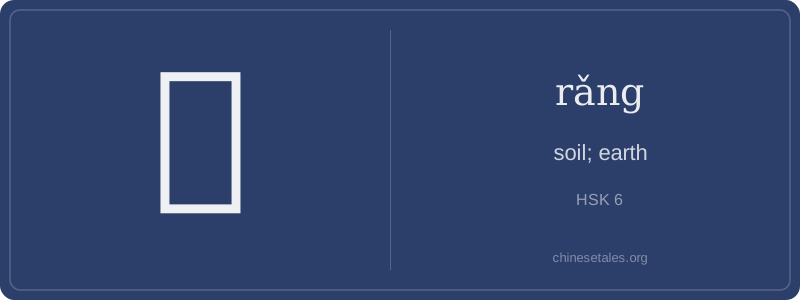
The earliest form of 壤 appears in Warring States bamboo slips — not as a pictograph of dirt, but as a carefully structured ideograph: top-left 土 (earth), bottom-right 襄 (xiāng, 'to assist, to enclose'), with an implied 'layered structure' in between. Look closely at the modern 20-stroke form: the left radical 土 anchors it literally and semantically; the right side 襄 (10 strokes) originally depicted hands lifting a vessel over a field — symbolizing *human labor applied to earth*. Over centuries, clerical script smoothed its angularity, but kept the core idea: soil made meaningful through cultivation, not just geology.
This semantic refinement is ancient: in the Mencius (3B:9), the phrase '深耕易耨,以待其成' ('plow deeply, weed easily, awaiting its fruition') implicitly references 壤 — not barren ground, but soil prepared for virtue and harvest. The character’s visual weight (20 strokes!) mirrors its conceptual heft: it’s never thrown away lightly. Even today, when officials speak of '筑牢生态之壤' ('strengthening the ecological foundation'), they’re invoking this 2,300-year-old fusion of labor, loyalty, and land.
At its heart, 壤 (rǎng) isn’t just ‘soil’ — it’s *cultivated earth*, the rich, layered, life-giving ground that has fed Chinese civilization for millennia. Unlike the neutral 土 (tǔ, 'dirt' or 'earth' in general), 壤 carries quiet reverence: it’s the soil you till, the land you inherit, the fertile matrix of agriculture and ancestry. You’ll rarely see it alone; it almost always appears in compounds like 肥壤 (féi rǎng, 'fertile soil') or 故壤 (gù rǎng, 'native soil'), evoking deep-rooted belonging.
Grammatically, 壤 is a noun-only character — no verb forms, no adjectival use. It never takes aspect markers (了, 过) or reduplication, and crucially, it doesn’t appear in colloquial speech. You won’t hear it in market haggling or casual chats; it lives in formal writing, ecological reports, classical poetry, and political rhetoric about 'national territory' or 'cultural soil'. A common mistake? Using it where 土 or 泥 would be natural — saying *这壤很湿* sounds like quoting a Han dynasty agronomist at a coffee shop.
Culturally, 壤 embodies the Confucian-tinged ideal of harmony between people and land: not raw nature, but *transformed* nature — tilled, tended, entrusted across generations. In the Book of Documents, the phrase '厚德载物,地势坤,君子以厚德载物' subtly invokes 壤-like qualities — earth as patient, sustaining, morally grounded. Learners often mispronounce it as rāng (flat tone) — but the third tone (rǎng) is non-negotiable: it’s the dip-and-rise of a plow cutting into soft, yielding loam.