妄
Character Story & Explanation
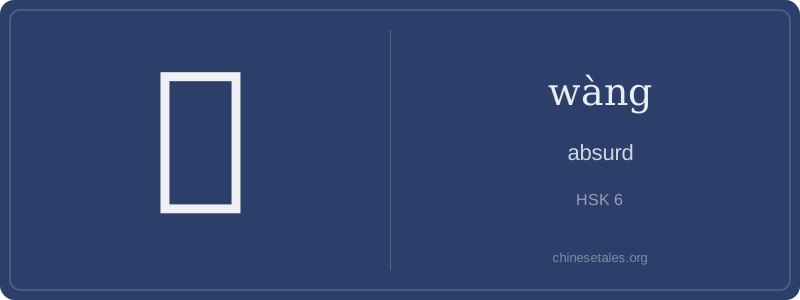
The earliest form of 妄 appears in Warring States bamboo slips as a compound: the left side was 女 (nǚ, 'woman'), and the right was 亡 (wáng, 'to perish, to lose') — not the modern 亡 we see today, but an older variant with a horizontal stroke above 亡, suggesting 'loss of control' or 'disappearance of restraint'. Over centuries, the right component simplified and fused, losing its top stroke, while the left 女 radical remained visually anchored — preserving the ancient association between unbridled behavior and gendered social expectations (though this bias has long been linguistically abstracted).
By the Han dynasty, 妄 had crystallized into its modern six-stroke shape, appearing in texts like the Huainanzi to criticize rulers who acted 'without ritual or reason' (妄行). The character’s evolution mirrors its semantic tightening: from a general sense of 'loss of proper conduct' to a precise philosophical term for epistemic hubris. Interestingly, the same visual structure — 女 + 亡 — subtly echoes the idea that when reason 'perishes' (亡), judgment becomes 'female-coded' in classical discourse (not as sexist as it sounds — 女 here functions more as a grammatical anchor than a meaning carrier, much like how 心 'heart' appears in emotion words regardless of gender). The stroke count — six — even feels fitting: minimal yet charged, like a warning tap on the shoulder.
At its core, 妄 (wàng) carries the visceral sense of 'unfounded boldness' — not just 'absurd', but something rashly assumed without basis, like a claim made in ignorance or arrogance. It’s never neutral: it always implies a breach of reason, propriety, or evidence. Think of it as the linguistic red flag for intellectual overreach — the moment someone declares 'I know how to fix the economy!' after reading one blog post.
Grammatically, 妄 almost never stands alone. It’s a prefix-like modifier attached to verbs (e.g., 妄想 wàngxiǎng 'to delude oneself', 妄言 wàngyán 'to speak recklessly') or appears in fixed four-character idioms (成语). Crucially, it’s not used for mild exaggeration ('That’s absurd!') — English speakers often overuse it where Chinese would use 荒唐 (huāngtáng) or 可笑 (kěxiào). Instead, 妄 marks moral-epistemic trespass: 'He妄断 the outcome' means he arrogantly jumped to conclusions *without authority or grounds* — a subtle but critical nuance.
Culturally, 妄 is steeped in Confucian and Daoist ethics: classical texts like the Zhuangzi warn against 妄为 ('reckless action') as violating the natural order (道), while Buddhist sutras condemn 妄念 ('delusional thoughts') as root causes of suffering. Learners’ biggest mistake? Using it adjectivally like English 'absurd' — you’d never say *妄的计划*; instead, it’s 妄图制定计划 ('foolishly attempt to formulate a plan'). Its power lies in its moral weight, not descriptive flair.