宰
Character Story & Explanation
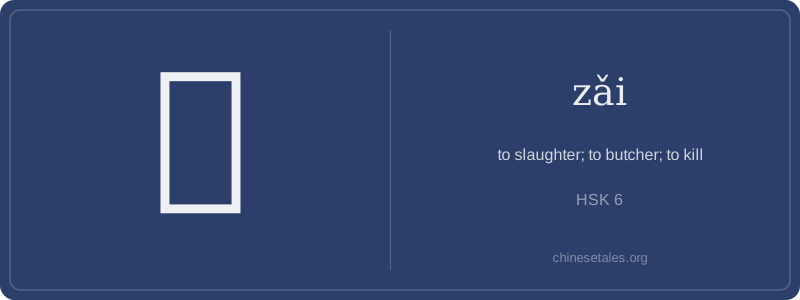
The earliest form of 宰 appears in bronze inscriptions as a compound pictograph: a roof (宀) sheltering a knife (刀) placed above a living creature — likely a pig (豕) or sheep (羊). Over time, the animal simplified into the lower component (a stylized leg or hoof), while the knife fused with the roof’s right stroke. By the seal script era, the shape stabilized into today’s 10-stroke structure: 宀 (roof) + (simplified animal) + 刀 (knife) — visually telling the story of 'cutting under cover', i.e., controlled, indoor, ritual slaughter.
This wasn’t random kitchen work — in Shang and Zhou dynasties, sacrificial slaughter was statecraft. The person who 宰’d animals for ancestral rites held ritual authority, eventually evolving into the highest civil post: 宰相 (prime minister), who 'dissected' governance like meat. Confucius himself referenced this metaphor: '治国如宰牛' ('Ruling a state is like butchering an ox') — demanding precision, timing, and deep knowledge of structure. So the character didn’t just name an act; it encoded a philosophy: mastery through intimate, authoritative understanding of systems — whether flesh or bureaucracy.
At its core, 宰 (zǎi) carries the visceral, unflinching weight of ritual slaughter — not just killing, but *controlled, purposeful, often ceremonial* killing. Think less 'stabbing in an alley' and more 'ancient temple sacrifice': it implies authority, procedure, and consequence. That’s why it’s rarely used for casual violence (you’d say 杀 for general 'kill'); instead, 宰 appears where power, duty, or grim expertise is involved — like a chef ‘butchering’ a whole duck, or a politician ‘slaughtering’ an opponent’s argument in debate.
Grammatically, 宰 is primarily a transitive verb — always needing an object (you 宰 something). It pairs naturally with animals (宰猪), abstract targets (宰对手的逻辑), or even ironically with people (别宰我!'Don’t rip me off!'). Watch out: learners often mistakenly use it as an intransitive verb ('He was slaughtered') — nope! You must say 他被宰了 (tā bèi zǎi le), using the passive 被. Also, avoid overusing it emotionally; while colloquial in slang (e.g., 宰客 'to rip off customers'), it still retains a sharp, slightly archaic edge.
Culturally, 宰 connects to ancient rites where slaughtering livestock was sacred labor — performed by officials, not butchers. That’s why 宰 later extended to high office (宰相 zǎixiàng, 'prime minister': literally 'the one who slaughters [i.e., dissects/controls] state affairs'). A common mistake? Confusing 宰 with 杀 (shā) — but 杀 is raw, immediate, and neutral; 宰 is deliberate, skilled, and loaded with hierarchy. Mastering 宰 means grasping how Chinese layers ritual precision onto even the most brutal acts.