两
Character Story & Explanation
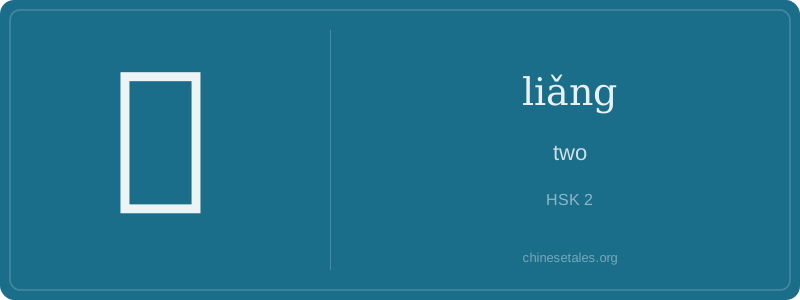
The earliest form of 两 appears on Shang dynasty oracle bones as a symmetrical pictograph resembling two opposing wings or banners flanking a central vertical line — possibly depicting a pair of ceremonial flags or twin yokes used to harness two oxen. Over centuries, the wings simplified into two parallel horizontal strokes above and below a central line, then fused into today’s clean structure: two short horizontals sandwiching a longer one, all anchored by the radical 一 (‘one’) — symbolizing unity *within* duality. Its seven strokes aren’t random: the top stroke (一), middle stroke (一), and bottom stroke (一) are balanced — a visual echo of its meaning.
By the Warring States period, 两 had solidified as the standard counter for paired, physical objects — appearing in texts like the *Zuo Zhuan*, where it describes 'two armies' (两军) facing off. Interestingly, its shape never became ‘2’-like (unlike 二); instead, its symmetry emphasized equivalence and reciprocity — not mere enumeration. Confucian classics later leveraged this duality for ethical concepts: 两仪 ('the two primary forces' — yin and yang) shows how 两 evolved from counting cattle to framing cosmic balance. The character’s quiet geometry still whispers: 'true twoness is mirrored, measured, and mutually dependent.'
At first glance, 两 just means 'two' — but in Chinese, it’s the *only* word for 'two' you use before measure words (like 两个人, 两本书). Unlike English where we say 'two people' and 'a couple of books', Chinese requires 两 *every time* you’re counting tangible things — never 二. That’s because 二 is reserved for math, dates, phone numbers, and abstract sequences (e.g., 第二名 'second place'). So 两 isn’t just a number — it’s a grammatical key that unlocks how Chinese quantifies reality: concrete, countable, embodied.
Grammatically, 两 behaves like a numeral-adjective: it always comes directly before a noun + measure word (e.g., 两杯水 — 'two cups of water'), never alone as a subject ('Two? No — 两个!'). Learners often mistakenly say *二个* — which sounds jarringly unnatural, like saying 'twos apples' in English. Also, 两 is the only number that doubles as a noun meaning 'both sides' (as in 两边 'both sides') — a subtle but frequent usage in directions, debates, and relationships.
Culturally, 两 reflects the Chinese preference for balance and reciprocity: think 两全其美 ('to satisfy both sides perfectly') or 两小无猜 ('childhood sweethearts, innocent of suspicion'). It’s not just quantity — it’s harmony between duality. A common mistake? Using 两 with abstract nouns like time or emotions — no, you’d say 两次 (two times), not *两*次. The character quietly enforces a worldview where 'two' only counts when it’s something you can hold, see, or share.