屏
Character Story & Explanation
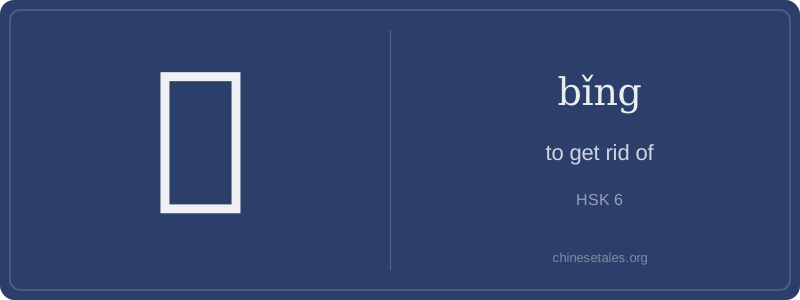
The earliest form of 屏 appears in bronze inscriptions as a combination of 户 (a stylized doorframe) and 并 (bìng, 'together; to join') — but here, 并 acts phonetically while 户 anchors meaning. Over time, 并 simplified into what looks like 尸 + 丌, then evolved into the modern upper part: a horizontal stroke over two short verticals, mimicking the act of *slamming a door shut* on something. The nine strokes weren’t arbitrary — the first three strokes (⺍) sketch the door’s lintel and posts, while the lower part suggests forceful motion outward. By the Han dynasty, the shape stabilized into today’s form: door radical on the left, decisive action on the right.
This visual logic fueled its semantic journey. In the *Zuo Zhuan* (c. 4th c. BCE), 屏 was used to describe exiling corrupt ministers — literally 'shutting them beyond the palace gate'. Later, in Neo-Confucian texts like Zhu Xi’s commentaries, 屏 expanded metaphorically: 屏气 (bǐngqì, 'hold one’s breath') reflects suppressing physical impulse to achieve mental clarity. So the door isn’t just architectural — it’s the boundary between chaos and cultivation, making 屏 a quiet powerhouse of ethical discipline.
Let’s crack open 屏 (bǐng) like a linguistic walnut. At its heart, it means 'to get rid of' — but not casually. Think of it as *forcibly expelling* something unwanted: distractions, doubts, impurities, or even people. It’s a high-register, literary verb — you’d rarely hear it in casual chat, but you’ll spot it in essays, political speeches, and classical-style writing. Notice the radical 户 (hù): originally a pictograph of a door, symbolizing an entry point — so 屏 implies *blocking at the threshold*, shutting something out before it crosses the line.
Grammatically, 屏 is almost always used in compound verbs like 屏弃 (bǐngqì, 'to discard utterly') or 屏除 (bǐngchú, 'to eliminate'). It’s transitive and often paired with abstract nouns: 屏蔽杂念 (bǐngbì zániàn, 'screen out distracting thoughts'), or 屏退侍从 (bǐngtuì shìcóng, 'dismiss attendants'). Learners often mistakenly use it alone — but native speakers virtually never say *'我屏了它'*; it needs a partner word. Also beware: 屏 is tone 3 (bǐng), not tone 2 — mispronouncing it as bīng makes it sound like 'ice' (冰), and as bǐng (like 'bing') it rhymes with 'sing', helping you lock in the tone.
Culturally, this character carries Confucian weight — it’s about moral self-discipline: purging selfish desires (屏私欲), rejecting flattery (屏谀词), or clearing the mind for virtue. A common learner trap? Confusing it with 屏 (píng) meaning 'screen' (as in computer screen) — same spelling, different tone and meaning! That píng version uses the same character but comes from a completely different root (a standing barrier), showing how tone changes everything in Chinese.