屡
Character Story & Explanation
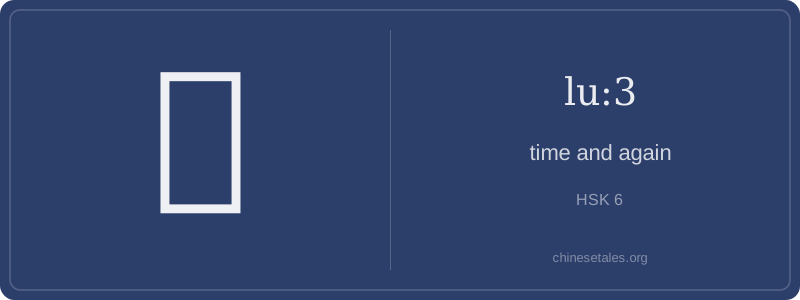
The earliest form of 屡 appears in bronze inscriptions as a compound: the top was 米 (mǐ, 'rice grains'), symbolizing abundance or accumulation, and the bottom was 尸 (shī, 'corpse' or 'person sitting'), representing a seated figure — together suggesting someone repeatedly performing an action while seated (perhaps tallying, recording, or enduring). Over time, 米 morphed into 呂 (lǚ, 'a pair of bells' — also a phonetic component), and 尸 remained as the semantic radical, anchoring the idea of embodied, repeated action. By the seal script era, the structure solidified: two 'mouths' (呂) stacked vertically over 尸 — visually echoing rhythmic, back-to-back occurrences.
This visual rhythm directly shaped its meaning: classical texts like the Zuo Zhuan used 屡 to describe ritual repetitions (e.g., 屡盟 — 'repeatedly forming alliances'), where each act carried political weight. The 尸 radical subtly reinforces this — not as death, but as the 'still, observing presence' witnessing recurrence. In Tang poetry, 屡 appears in lines like '屡欲起,复止' ('I repeatedly tried to rise, then stopped again'), capturing psychological hesitation. Its evolution reflects how Chinese writing turns physical posture (sitting, tallying, watching) into grammatical nuance — repetition not as mere quantity, but as witnessed, consequential, and often wearying.
Think of 屡 (lǚ) as the Chinese equivalent of 'yet again' — not just 'often', but with a subtle sigh, a raised eyebrow, or even exasperation. It conveys repetition that feels inevitable, habitual, or stubbornly recurring: 屡教不改 (repeatedly taught, yet uncorrected), 屡战屡败 (fought many times, lost every time). Unlike generic frequency words like 经常 (jīngcháng, 'often') or 总是 (zǒngshì, 'always'), 屡 carries narrative weight — it’s the word you’d use in news reports, historical analysis, or moral commentary where repetition reveals character, failure, or systemic patterns.
Grammatically, 屡 is an adverb that *must* precede verbs — never used alone as a noun or adjective. It pairs naturally with 成 (chéng, 'to succeed'), 败 (bài, 'to fail'), 犯 (fàn, 'to commit [a mistake]'), and 见 (jiàn, 'to see/occur'). Learners often mistakenly insert it after the verb ('×失败屡') or confuse it with the noun-like 次 (cì, 'time') — but 屡 isn’t about counting; it’s about *patterned recurrence*. Also beware tone: it’s lǚ (third tone), not lū or lù — mispronouncing it as lù risks confusion with 露 (lù, 'to reveal') or 路 (lù, 'road').
Culturally, 屡 appears heavily in official discourse and classical idioms — think of Confucian admonitions against repeated moral lapses or modern headlines like '该企业屡遭投诉' (This company has been repeatedly complained about). Its gravitas makes it rare in casual speech; saying 屡试不爽 (lǚ shì bù shuǎng — 'tried repeatedly, never disappointed') sounds almost literary. A common error? Using it for neutral, pleasant repetition ('×她屡去咖啡馆'); instead, opt for 总是 or 经常. 屡 implies consequence — it’s repetition with a story attached.