峡
Character Story & Explanation
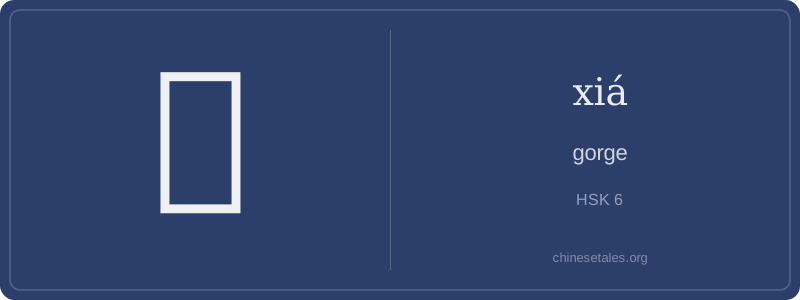
The earliest form of 峡 appears in seal script (around 300 BCE), where it combined 山 (shān, mountain) on the left with 夹 (jiā, to grip/clamp) on the right—a brilliant visual pun. The original pictograph wasn’t a literal drawing of a gorge but a conceptual one: two mountain peaks gripping something tightly, like hands clamping down. Over centuries, the right side simplified from 夾 (with two ‘human’ radicals) to 夹 (two ‘crossed arms’), then to the modern simplified 夹 component—still powerfully evoking compression. The left 山 radical stayed constant, anchoring it in terrain.
This ‘mountains gripping’ idea proved so potent that by the Han dynasty, 峡 was already standard in texts like the *Shuǐjīng Zhù* (Commentary on the Water Classic), describing narrow river passages where water rushed violently between cliffs. Its meaning never wavered—it didn’t drift into ‘valley’ or ‘canyon’ broadly, but remained specifically for *constricted*, *steep-walled* passages. Interestingly, the character’s tight stroke count (9 strokes) mirrors its semantic narrowness: compact, focused, unyielding—just like the landform it names.
At its heart, 峡 (xiá) isn’t just a geological term—it’s a visceral Chinese experience of space: narrow, deep, dramatic, and charged with tension. Think of the Yangtze’s Three Gorges—where towering cliffs squeeze the river into a roaring, sun-dappled channel. In Chinese, 峡 evokes awe, danger, and passage; it’s rarely neutral. You’ll almost never say ‘a nice little gorge’—it’s always *the* gorge, *that* gorge, or *the* Three Gorges, carrying weight like a proper noun.
Grammatically, 峡 is almost always a noun and appears in compound nouns (e.g., 三峡, 峡谷) rather than alone. Learners sometimes mistakenly use it as a verb ('to gorge') or try to pluralize it (‘gorges’)—but Chinese doesn’t pluralize nouns, and 峡 has no verbal form. It also never stands alone in speech: you’d say ‘穿过峡谷’ (chuān guò xiá gǔ), not just ‘穿过峡’. Even in poetic usage—like Li Bai’s ‘两岸猿声啼不住,轻舟已过万重山’—the gorge is implied through landscape, not named directly, showing how deeply embedded the *idea* of constriction is in classical imagery.
Culturally, 峡 symbolizes both obstacle and gateway—geographic barriers that shaped migration, trade, and even poetry. Modern learners often mispronounce it as ‘xiǎ’ (third tone) due to confusion with similar-sounding words, but it’s firmly first tone: xiá. And beware: while English uses ‘gorge’ for both landforms and eating, Chinese never conflates them—no culinary meaning here! That’s all 下 (xià) or 嚼 (jiáo). This character stays high, steep, and solemn.