崭
Character Story & Explanation
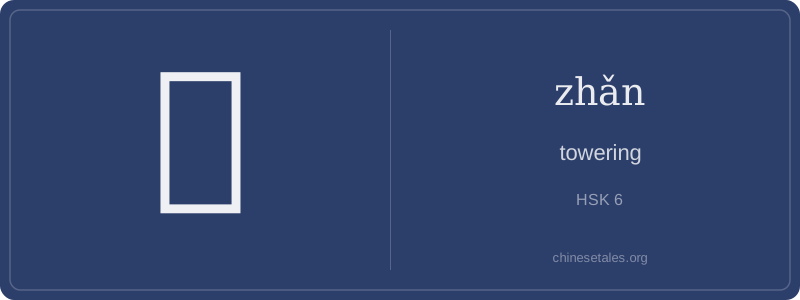
The earliest form of 崭 appears in seal script (c. 3rd century BCE), where it clearly combines 山 (shān, 'mountain') on the left with 斩 (zhǎn, 'to chop, cut down') on the right — not as violence, but as a phonetic-semantic compound. The mountain radical anchors the meaning in elevation and terrain, while 斩 provides the sound and hints at sharpness: imagine a blade slicing cleanly through mist to reveal a razor-edged cliff face. Over centuries, the right side simplified from the full 斩 (with 戊 + 车) to today’s streamlined 斩-like shape — keeping the visual punch of decisive, angular force.
This duality — mountain + sharp action — crystallized into 'towering' by the Tang dynasty. In Du Fu’s poetry, phrases like '崭然见孤峰' ('suddenly, a solitary peak towers forth') show how 崭 captured not just height, but sudden, dramatic emergence — as if the mountain had been 'cut free' from obscurity. Its semantic path wasn’t just upward, but unveiling: the act of revealing something imposing and unmistakable. That’s why it later extended to abstract 'newness' — a崭new idea doesn’t just appear; it breaks through like a summit piercing clouds.
At its heart, 崭 (zhǎn) evokes vertical power — not just 'tall', but soaring, sharp-edged, freshly imposing. Think jagged mountain peaks piercing cloud cover, or a brand-new skyscraper gleaming under sun. It’s rarely used alone; it almost always appears in the compound 崭新 (zhǎn xīn), meaning 'brand-new' — but crucially, not just new in time, rather new in vivid, unblemished, almost startling quality. That ‘towering’ sense transfers metaphorically: something so new it feels architecturally bold, visually dominant, even slightly intimidating in its freshness.
Grammatically, 崭 is strictly an adjective and only functions within compounds — never as a standalone predicate (*他崭 is ungrammatical). Its most vital role is in 崭新, where it modifies 新 like an intensifier with texture: not merely 'new' (xīn), but 'toweringly new'. You’ll also see it in literary or formal contexts describing landscapes (崭峰, zhǎn fēng — 'jagged peak') or rhetoric (崭露头角, zhǎn lù tóu jiǎo — 'to emerge prominently'). Learners often misplace it — trying to say 'very new' as *崭的* (zhǎn de), but that’s wrong: it doesn’t take 的, and never stands before nouns like a typical adjective. It’s a fused, poetic modifier — more like a flavor than a label.
Culturally, 崭 carries subtle connotations of modernity, ambition, and even political aspiration — you’ll find it in slogans about 'a崭new era' or '崭new achievements', subtly invoking both natural grandeur and human progress. A classic mistake? Confusing it with 暂 (zàn, 'temporarily') — same sound, totally different meaning and radical. Also, don’t expect it in casual speech: it’s HSK 6 for good reason — it lives in writing, speeches, and descriptive prose, not café chatter.