巡
Character Story & Explanation
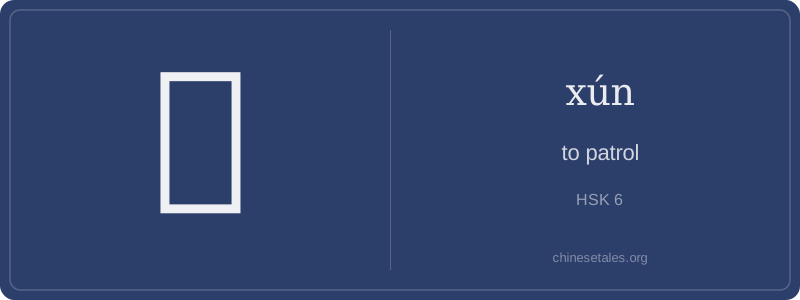
The earliest form of 巡 appears in Western Zhou bronze inscriptions as a compound pictograph: a person (人) walking along a winding path (巛, representing flowing water or meandering terrain), with a hand-held staff or banner (represented by the top stroke, later stylized into 丿). Over time, the person evolved into the left-side component (a variant of , related to ‘walk’), while the winding path (巛) became the radical at the bottom—visually anchoring the idea of traversing irregular, extended ground. The six strokes coalesced into today’s elegant, balanced shape: three on top (丿丨一), three below (巛), mirroring motion across terrain.
This visual logic directly shaped meaning: from early texts like the *Zuo Zhuan*, 巡 described feudal lords touring their fiefs to assess harvests and resolve disputes—movement that was neither travel nor migration, but sovereign presence made visible. By the Han dynasty, 巡 became institutionalized: the Emperor’s 巡狩 symbolized cosmic order, while local officials conducted 巡行 (xúnxíng) to enforce law and collect taxes. Even in Tang poetry, Du Fu wrote of ‘巡檐索共梅花笑’—not random wandering, but a slow, intentional circuit beneath eaves, echoing the character’s ancient geometry of disciplined return.
At its core, 巡 (xún) evokes the quiet, deliberate rhythm of movement—like a guard walking a fixed route, or an official inspecting distant counties. It’s not frantic running (跑), nor casual strolling (逛); it’s purposeful, cyclical, and authoritative. Think of a Ming dynasty magistrate circling his jurisdiction—not just passing through, but observing, verifying, asserting presence. That sense of systematic oversight remains central: 巡 always implies duty, scope, and return.
Grammatically, 巡 is almost never used alone in modern speech—it’s a ‘bound morpheme’ that thrives in compounds (e.g., 巡逻, 巡视, 巡回). You’ll rarely say *‘I xún the street’*; instead, you *‘xúnluó the street’* (patrol) or *‘xúnshì the factory’* (inspect). Learners often mistakenly use it as a standalone verb like ‘to patrol’, leading to unnatural phrasing. Also beware: 巡 is formal and institutional—never for ‘checking your phone’ or ‘browsing a website’. That’s 浏览 or 查看.
Culturally, 巡 carries imperial weight: in classical texts, 巡狩 (xúnshòu) meant the emperor’s ritual tours to affirm sovereignty and receive tributes—a blend of governance, cosmology, and performance. Today, that legacy lingers in phrases like 巡视组 (xúnshì zǔ), the powerful Central Inspection Teams that ‘tour’ Party organs to root out corruption. Mistaking 巡 for similar-sounding verbs like 循 (xún, ‘to follow’) or 寻 (xún, ‘to search’) isn’t just semantic—it erases centuries of administrative gravity.