帝
Character Story & Explanation
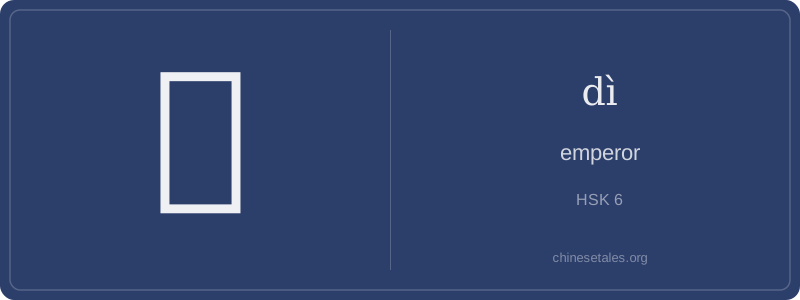
The earliest form of 帝 appears in Shang dynasty oracle bone inscriptions — not as a crown or throne, but as a stylized altar or sacrificial platform with crossed lines representing ritual offerings, flanked by vertical strokes suggesting sacred posts or banners. Over centuries, the top evolved into the ‘upper canopy’ (the two horizontal strokes + crossbar), the middle became the ‘offering vessel’ (the ‘冂’-like enclosure), and the bottom solidified into 巾 (jīn), originally depicting a ceremonial cloth draped over the altar — not just any cloth, but the one used in ancestral rites. By the Qin dynasty, the character had stabilized into today’s nine-stroke form, visually echoing the layered hierarchy of Heaven, Ruler, and Ritual.
This altar origin explains everything: 帝 wasn’t about military might first — it was about mediating between Heaven and humanity. In the *Shūjīng* (Book of Documents), Yao and Shun are called ‘Dì’ not because they ruled vast lands, but because they performed perfect rites and maintained cosmic balance. Even Confucius praised ‘Dì shùn’ (Emperors Yao and Shun) as moral paragons — their power flowed from virtue, not force. The 巾 radical at the bottom? It’s no accident: in ancient rites, the emperor himself would drape ceremonial cloths on altars — making the character a self-referential glyph: ‘the one who places the cloth on Heaven’s altar’.
At its heart, 帝 (dì) isn’t just ‘emperor’ — it’s the weight of cosmic authority. In classical Chinese, it evokes the ‘Son of Heaven’, a ruler whose legitimacy came not from armies or bloodline alone, but from harmony with Heaven (天) and Earth (地). That’s why you’ll rarely hear it used casually: saying ‘my boss is like an emperor’ in Chinese wouldn’t be ‘tā xiàng yí gè dì’, but rather ‘tā xiàng yí gè bàwáng’ — because 帝 carries sacred, almost ritual gravity. It’s not a job title; it’s a metaphysical office.
Grammatically, 帝 is almost never used alone in modern speech — you won’t say *‘dì zài gōngyuàn lǐ sàn bù’* (‘The emperor walks in the garden’) as a standalone sentence. Instead, it appears in compounds (like 帝王, 帝国) or formal/historical contexts: ‘Táng Dì’ (Tang Emperor) refers to a specific reign, while ‘dì wèi’ (imperial throne) signals institutional power. Crucially, it’s *not* used for living rulers — China hasn’t had an emperor since 1912, so 帝 is strictly historical, literary, or mythological.
Learners often mistakenly use 帝 where they mean ‘king’ or ‘ruler’ — but 王 (wáng) is the correct, neutral term for monarchs (e.g., 英国王); 帝 implies universal sovereignty, divine mandate, and Han-Chinese imperial tradition. Another trap: confusing it with 帝国 (empire) and thinking it means ‘country’. No — 帝国 is *the system*, not the land. Also, note that 帝 never takes aspect markers (了, 过) or aspectual verbs (在, 正在) — it’s frozen in its ceremonial dignity.