庸
Character Story & Explanation
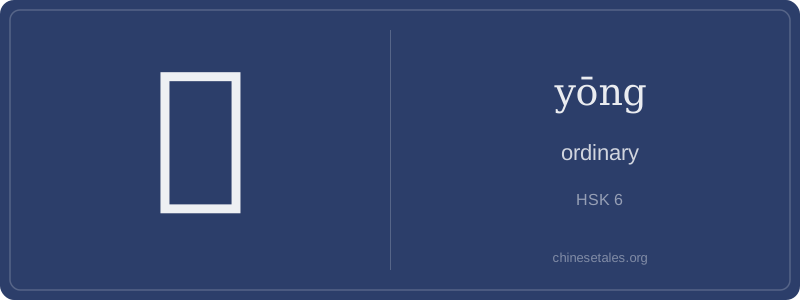
Oracle bone inscriptions show no direct precursor for 庸, but its bronze script form already featured the radical 广 (yǎn, 'roof' or 'shelter') over a component resembling 用 (yòng, 'to use'). Over centuries, the lower part simplified and stylized: the original 用 — with its distinctive 'bucket-and-handle' shape — gradually lost its top stroke and rounded into the modern 甬 (yǒng), a phonetic hint (since 庸 and 甬 share the same Middle Chinese initial and rhyme). The 广 radical remained, evoking enclosure, stability, and social space — not a physical roof, but the ‘roof’ of acceptable, normative behavior.
This visual logic mirrors its semantic evolution: from ‘usable, fit for purpose’ (early texts like the *Zuo Zhuan*) to ‘conforming to the standard’, then to Confucius’ profound concept of 中庸 — the ‘Doctrine of the Mean’, where virtue lies precisely in balanced, unexaggerated action. Mencius later praised ‘the庸 man who follows ritual without question’. Even in Tang poetry, 庸 appears in self-deprecating lines like ‘臣本布衣,躬耕于南阳,苟全性命于乱世,不求闻达于诸侯’ (Zhuge Liang’s *Chu Shi Biao*), where 庸 subtly underlines humble, dutiful ordinariness as moral strength — not weakness.
At its heart, 庸 (yōng) isn’t just ‘ordinary’ — it’s the quiet dignity of the unremarkable: dependable, unflashy, and socially appropriate. Think less ‘boring’ and more ‘reliably functional’, like a well-worn wooden spoon or a seasoned civil servant who never seeks applause. In classical Chinese, it carried strong Confucian weight — ‘the Mean’ (中庸, zhōng yōng), meaning balanced, moderate virtue — not mediocrity, but *perfectly calibrated* action. That nuance still echoes today.
Grammatically, 庸 is rare as a standalone adjective in modern speech (you’d say 普通 or 一般 instead), but it shines in set phrases and formal writing. It often appears in compound nouns (e.g., 平庸) or as part of literary idioms. Watch out: learners sometimes misread 庸 as ‘common’ and slap it into casual sentences like ‘这个电影很庸’ — which sounds jarringly archaic or even nonsensical. It doesn’t work that way. Instead, you’ll find it paired with other characters to form nuanced abstractions: 平庸 (mediocre), 庸俗 (vulgar/tasteless), or 庸医 (quack doctor).
Culturally, 庸 carries subtle judgment — not moral failure, but a gentle, almost sorrowful disappointment in *unrealized potential*. Calling someone 平庸 isn’t rude per se, but it’s a quiet verdict on lack of distinction. And crucially: despite its ‘ordinary’ gloss, 庸 has zero neutral connotation in compounds — it almost always leans slightly negative (e.g., 庸碌, 庸才). That’s why HSK 6 includes it: mastery means grasping this layered, context-dependent gravity.