彰
Character Story & Explanation
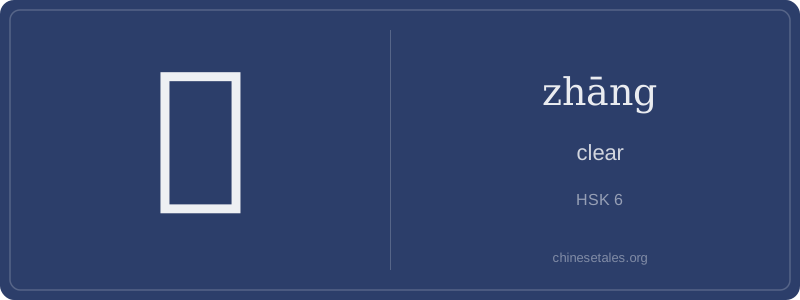
The earliest form of 彰 appears in bronze inscriptions as a combination of 彡 (shān, 'ornamental strokes') and 章 (zhāng, originally a pictograph of a beautifully patterned yu (jade tablet) under a canopy — symbolizing ceremonial distinction). The 彡 radical wasn’t decorative fluff: it represented *radiating lines*, like light bursting from a source or the bold strokes of a master calligrapher’s brush. Over centuries, the top simplified to 彑 (a variant of 彑, derived from 章’s upper part), and the lower part solidified into 彡 — preserving that core idea of *visible, intentional brilliance*.
By the Han dynasty, 彰 had shifted from describing physical ornamentation to signifying *moral or intellectual luminosity*: to ‘make virtue conspicuous’, as in Sima Qian’s Records of the Grand Historian. Its visual DNA — radiating strokes atop a structure of order — mirrors its semantic role: not passive clarity, but active revelation. Even today, when officials ‘promote exemplary conduct’, they use 彰显 — literally ‘shine-forth-show’ — echoing the ancient ritual of displaying jade tablets under open sky to affirm truth.
Imagine you’re standing before a Tang dynasty stele carved with an imperial edict — the characters aren’t faded or smudged, but sharply incised, radiant with authority. That’s 彰 in action: not just ‘clear’ as in transparent glass, but clarity that *shines forth*, that *makes something unmistakably visible and undeniable*. It’s the kind of clear that carries weight — moral clarity, evidence so vivid it silences doubt, fame so luminous it can’t be ignored.
Grammatically, 彰 is almost never used alone; it lives in formal compounds and literary verbs like 彰显 (zhāng xiǎn, 'to highlight/emphasize') or 彰明 (zhāng míng, 'to make evident'). You won’t say ‘this water is 彰’ — that’s wrong! It modifies abstract concepts: 彰显正义 (highlight justice), 彰明较著 (so obvious it’s glaring). Learners often mistakenly treat it like 明 (míng, 'bright/clear') and slap it into casual speech — but 彰 belongs in essays, policy documents, and classical allusions, not coffee shop chatter.
Culturally, 彰 carries Confucian gravitas: it’s about making virtue *visible to society*, not just feeling it inwardly. In the Book of Rites, sages are praised for 彰善瘅恶 (zhāng shàn dàn è) — ‘making goodness shine forth and condemning evil’. A common mistake? Using 彰 where 章 (zhāng, 'chapter/section') or 张 (zhāng, 'to stretch') fits — they look similar but belong to entirely different semantic universes.