径
Character Story & Explanation
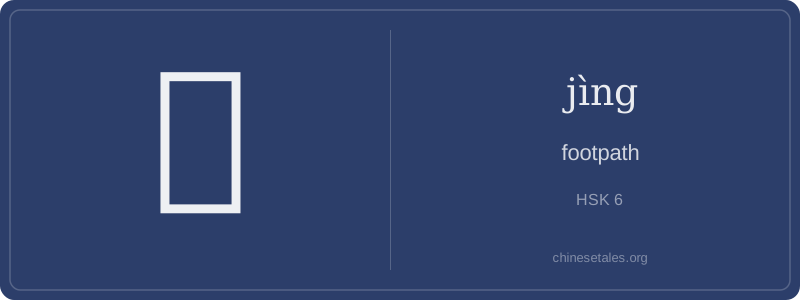
The earliest form of 径 appears in bronze inscriptions around 800 BCE: a left-side radical 彳 (chì), representing ‘footsteps’ or ‘movement’, paired with a right-side element that evolved from 巠 (jīng), an ancient pictograph of water flowing between two banks — suggesting a natural channel or furrow. Over centuries, the water element simplified into 巟 (a variant of 工 + 凵), then further stylized into 廴 + 工 in seal script, finally settling as the modern 又 + 工 shape in regular script. Crucially, the left 彳 was never decorative — it anchored the meaning in motion, making 径 inherently about *traversing*, not just static space.
This duality — water’s flow + footsteps’ intent — shaped its philosophical weight. In the Zhuangzi, ‘small paths between fields’ (田径) contrasted with imperial roads (道), symbolizing humble, authentic action versus rigid orthodoxy. By the Tang dynasty, poets like Wang Wei embedded 径 in lines like ‘曲径通幽处’ — where ‘winding path’ wasn’t just geography, but a metaphor for intuitive wisdom bypassing logic. Even today, the stroke order (starting with 彳’s two dots and vertical stroke) mimics the first steps onto a narrow trail — deliberate, grounded, quietly purposeful.
Think of 径 (jìng) as China’s version of a ‘back alley’ in a Jane Austen novel — not the grand boulevard, but the narrow, slightly secretive route that reveals character and intention. It means ‘footpath’, yes, but carries subtle connotations of directness, efficiency, or even audacity: to take a ‘short cut’ (捷径 jiéjìng) isn’t just practical — it’s a strategic choice with moral overtones in classical thought. Unlike generic ‘road’ characters like 路 (lù), 径 implies human-scale intimacy: winding, trodden, often secluded.
Grammatically, 径 is almost never used alone in modern speech — it lives in compounds (捷径, 曲径, 小径) or literary set phrases. You’ll rarely say *‘I walk on a jìng’*; instead, you ‘take a shortcut’ (走捷径 zǒu jiéjìng) or ‘follow a winding path’ (曲径通幽 qūjìng tōng yōu). A classic HSK 6 trap? Using 径 where 路 fits better — e.g., saying *‘地铁径’* (subway path) instead of *‘地铁线路’* (subway line). That’s like calling the London Underground ‘a footpath’ — technically traversable, but hilariously inaccurate.
Culturally, 径 appears everywhere from Taoist hermit poetry to modern business metaphors: ‘finding the right path to success’ is almost always 捷径, subtly implying both cleverness and potential ethical compromise. Learners often misread its tone (it’s fourth tone — sharp and decisive, like a footstep on gravel), and confuse it with similar-looking characters like 经 (jīng, ‘classic’ or ‘to pass through’) — a mix-up that turns ‘the path to enlightenment’ into ‘the Buddhist scripture to enlightenment’.