恍
Character Story & Explanation
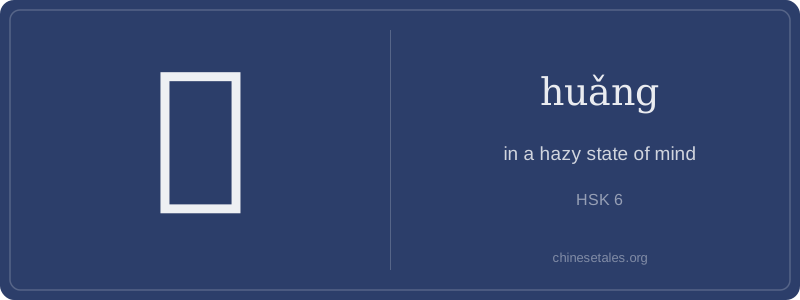
The earliest form of 恍 appears in seal script as a heart-radical (忄) fused with 光 (guāng, ‘light’) — not a pictograph of a thing, but a conceptual fusion: ‘heart + light’. Imagine ancient scribes carving this on bamboo slips: three dots for 忄 (the heart’s pulse), then the elegant, radiant strokes of 光 — a sun rising over a person’s head. Over centuries, the left side standardized into the modern 忄 radical (a stylized, vertical heart), while 光 simplified from its oracle-bone form (a flame above a person) to today’s nine-stroke shape — still unmistakably glowing.
This visual logic birthed its meaning: light that doesn’t illuminate clearly — like dawn mist diffusing sunlight, or candlelight shimmering behind silk. By the Tang dynasty, poets used 恍 to describe trance-like states in Daoist meditation texts and dream sequences in narrative verse. In the Classic of Poetry, it subtly conveys nostalgic yearning — not sorrow, but the soft blur of time softening memory. The character doesn’t mean ‘darkness’ or ‘ignorance’; it’s the gentle, luminous veil between awareness and absence — a uniquely Chinese philosophical nuance.
Think of 恍 (huǎng) as the linguistic equivalent of looking through frosted glass — not blind, not clear, but suspended in a soft, dreamy haze. It captures that fleeting, half-remembered mental state: when a memory surfaces like mist off a lake, or when you zone out mid-sentence and snap back with no idea what was just said. This isn’t just ‘confused’ or ‘dazed’ — it’s specifically *luminous uncertainty*: a mind touched by light (the right-side component 光 means ‘light’!) yet unable to focus. That paradox is key.
Grammatically, 恍 almost never stands alone. It appears almost exclusively in reduplicated forms — 恍恍惚惚 (huǎnghuǎnghūhū) for chronic mental fog, or paired with 忽 (hū) in 恍然 (huǎngrán), meaning ‘suddenly realizing’ — yes, the same root! The ‘aha!’ moment only makes sense *because* you were just in a 恍 state. Learners often mistakenly use it like an adjective (‘I feel huǎng’) — but it’s always part of a set phrase or compound; native speakers wouldn’t say *‘tā hěn huǎng’*.
Culturally, this character reflects a deep Chinese sensitivity to transitional mental states — not just ‘thinking’ or ‘not thinking’, but the liminal space between. In classical poetry (like Li Bai’s verses), 恍 evokes wistful, almost Daoist detachment. A common mistake? Confusing it with 彷 (páng) in 彷徨 (pánghuáng, ‘to wander indecisively’) — different radical, different weight: 彷 is physical hesitation; 恍 is internal luminosity gone soft.