耻
Character Story & Explanation
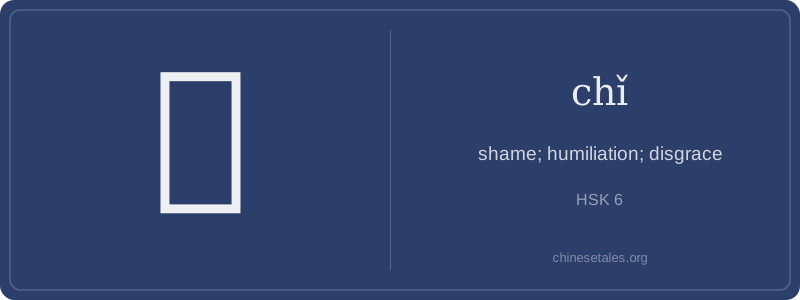
The earliest form of 耻 appears in bronze inscriptions as a compound: the left side was 耳 (ear), and the right was 止 (to stop, later stylized as ⺊ + 丨), but crucially — in oracle bone script, the right component resembled a kneeling person with hands bound behind their back, symbolizing public humiliation and enforced silence. Over centuries, the kneeling figure morphed into 止, while 耳 remained — not because ears ‘hear’ shame, but because in ancient ritual punishment, offenders were made to stand at the city gate *with ears exposed* as a visible mark of disgrace, their identity audibly announced to all who passed.
This visual logic endured: the ear radical signals publicness — shame isn’t felt in solitude, but *witnessed*. By the Han dynasty, 耻 appears in the Mencius (3A.5) as part of the ‘four beginnings’: 羞恶之心,义之端也 (‘The heart that feels shame and disgust is the beginning of righteousness’). The character’s structure — ear + ‘stopping’ — thus encodes a profound idea: shame is what *halts* unethical action *because* you imagine being heard, seen, and judged. Its evolution mirrors China’s long history of valuing communal conscience over individual conscience.
At its core, 耻 isn’t just ‘shame’ in the Western psychological sense — it’s a deeply social, almost physical sensation of moral exposure, like having your inner failings suddenly broadcast to the community. In Chinese thought, shame isn’t merely private guilt; it’s relational: you feel 耻 when you’ve let down family, teachers, or societal expectations — and others *see* it. That’s why it often appears with verbs like 感到 (feel), 觉得 (think/feel), or 深以为 (deeply regard as), rarely standing alone as a noun like 'shame' in English.
Grammatically, 耻 is almost never used bare — you won’t say *‘这是耻’* (This is shame) without context; instead, it’s embedded in structures like 不以为耻 (‘not consider it shameful’) or 有辱…之耻 (‘a disgrace to…’). It pairs powerfully with negation or comparison: 无耻 (shameless) is far more common than 耻 itself — a telling linguistic clue that Chinese discourse often defines virtue by naming its absence. Learners mistakenly treat it like an English abstract noun and try to pluralize or quantify it — but 耻 has no plural, no measure words, and resists standalone subjecthood.
Culturally, 耻 carries Confucian gravity: Mencius called it the ‘sense of shame’ (羞恶之心), one of four innate moral sprouts — not weakness, but the very foundation of ethical self-correction. That’s why calling someone 无耻 is among the harshest moral condemnations in Mandarin — it implies a severed connection to humanity’s shared moral compass, not just bad behavior.