恰
Character Story & Explanation
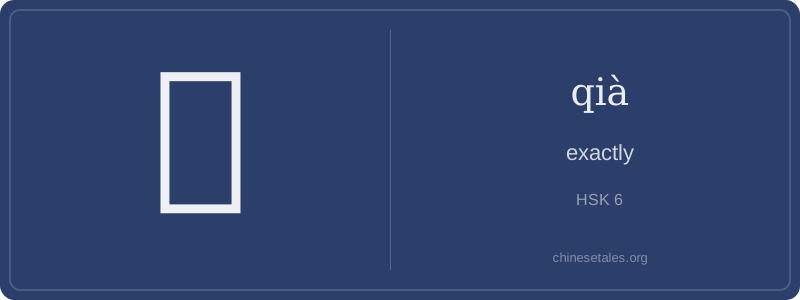
The earliest form of 恰 appears in seal script (c. 3rd century BCE), built from 忄 (the ‘heart-mind’ radical) on the left and 合 (hé, ‘to join/fit together’) on the right. Visually, it’s a heart engaged in synthesis — not emotion alone, but cognition *in alignment*. The left side evolved from the ancient pictograph for ‘heart’ (❤️-like shape), while 合 itself was originally two mouths (口口) under a lid (亼), symbolizing ‘covering mouths to agree’ — consensus sealed. Over centuries, strokes streamlined: the top of 合 flattened, the lower ‘mouth’ simplified, and the whole character gained elegant balance — nine strokes total, mirroring its meaning: compact, complete, uncluttered.
This visual logic became semantic truth. In classical texts like the *Book of Rites*, 恰 described ritual actions performed with flawless timing and sincerity — ‘the sacrifice offered *just so*’. By the Tang dynasty, poets used it to capture fleeting moments of resonance: ‘the moonlight falls *exactly* where the poem ends’. Its core idea never wavered: not mechanical accuracy, but heart-and-mind synchronicity with reality — the inner state matching the outer moment. That’s why modern Chinese still says 恰如其分 (qià rú qí fèn): ‘exactly appropriate’, where ‘fèn’ means ‘due measure’ — a concept rooted in moral proportion, not mere mathematics.
At its heart, 恰 (qià) isn’t just ‘exactly’ — it’s the quiet thrill of perfect alignment: timing, tone, quantity, or intention hitting the bullseye with zero margin for error. Think of a chef adding the final pinch of salt that transforms a dish from ‘good’ to ‘unforgettable’, or a diplomat choosing the one phrase that defuses tension. This character carries a subtle weight of precision-as-artistry, deeply resonant in a culture where harmony (hé) depends on getting things *just so* — not too much, not too little, but precisely right.
Grammatically, 恰 is almost always an adverb modifying verbs or adjectives, and it *requires* context to land — you’ll rarely see it alone. It pairs naturally with verbs like ‘arrive’, ‘say’, ‘appear’, or ‘fit’, and often appears in literary or formal registers. Learners mistakenly use it like English ‘exactly’ in casual speech (e.g., ‘Yes, exactly!’), but native speakers would say 正好 or 就是 instead; 恰 feels poetic, even slightly solemn. Try: 恰在此时 (qià zài cǐ shí) — ‘precisely at this moment’ — and you’ll feel its rhythmic gravity.
Culturally, 恰 reflects the Confucian ideal of zhōng yōng (the Golden Mean): virtue lies not in extremes, but in the perfectly calibrated middle. Misusing it — say, overstating certainty or forcing precision where flexibility is expected — can unintentionally sound pedantic or cold. And beware: it’s easily misread as 洽 (qià, ‘harmonious’) or 恰 (qià) vs. 适 (shì, ‘suitable’) — tiny stroke differences with big semantic consequences.