患
Character Story & Explanation
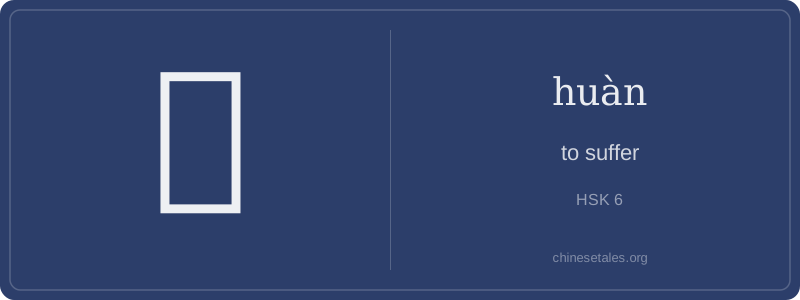
The earliest form of 患 appears in bronze inscriptions as a heart (心) cradled beneath two overlapping hands (), symbolizing *hands pressing down on the heart* — a visceral image of distress, suffocation, or oppressive worry. Over centuries, the top evolved into 夂 (a variant of 攵, 'to act') + 串 (a string of coins, later stylized), while the bottom solidified as 心. By the seal script, the structure was clear: two components above (indicating action or accumulation) and 心 below (the seat of emotion). The 11 strokes now encode both physical pressure and emotional consequence.
This visual logic shaped its meaning: from early Zhou texts like the Book of Documents, 患 meant 'to fear impending disaster'; by the Warring States period, Mencius used it to describe rulers who '患民之饥' ('feared their people’s hunger') — not just feeling sorrow, but being *troubled by* and *responsible for* the threat. The heart radical isn’t decorative: it anchors 患 in the realm of conscious, morally weighted concern — not mere sensation. Its evolution mirrors China’s shift from divination-based anxiety to human-centered governance: to 患 is to feel the weight of consequence.
Imagine a scholar in the Han dynasty, pale and trembling, clutching his chest as he reads a grim imperial edict: 'The northern border is under siege — the state huàn has deepened.' That word — 患 — doesn’t just mean 'to suffer' like a passive ache; it carries the weight of *active, looming danger*: illness, threat, anxiety, or crisis that demands vigilance. It’s never casual — you wouldn’t say 'I 患 a cold' (that’s 得感冒); instead, you 患病 (huàn bìng) — 'suffer from disease' — implying the disease has taken hold, not just tickled your throat.
Grammatically, 患 is almost always transitive and formal. It pairs with abstract nouns: 患忧 (huàn yōu, 'suffer anxiety'), 患难 (huàn nàn, 'share hardship'), or appears in classical constructions like '患...甚矣' ('the problem is severe'). Learners often mistakenly use it as an intransitive verb ('He suffers') without an object — but 患 *requires* what is suffered: 患癌 (huàn ái, 'suffer cancer'), not *他患*. It rarely stands alone — it’s a verb that insists on naming the burden.
Culturally, 患 echoes Confucian awareness of fragility: to 患 is to recognize vulnerability — in body, state, or virtue. Mistaking it for casual distress (like 害怕 or 难受) strips it of its gravity. And beware tone — huàn (4th) is easily confused with huān (1st, 'joy') or huǎn (3rd, 'slow'); saying 'I huān cancer' would be darkly comic — and very wrong.