事
Character Story & Explanation
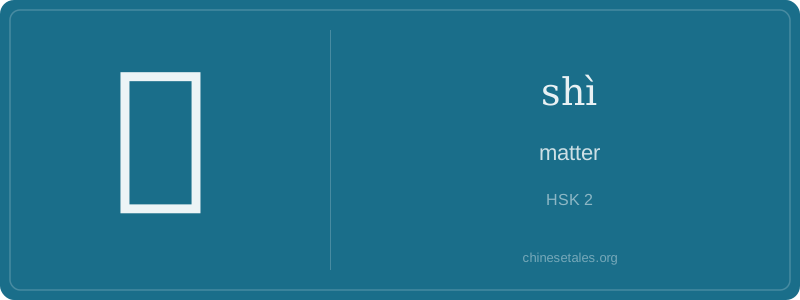
The earliest form of 事 appears in Shang dynasty oracle bone inscriptions as a pictograph resembling a hand holding a ceremonial axe or weapon () above a mouth (口) — symbolizing an official act performed under authority, like pronouncing judgment or conducting ritual. Over centuries, the axe morphed into the top component (一 + 丨), while the mouth simplified and shifted downward; by the Qin seal script, the shape had stabilized into something close to today’s 事 — eight strokes, with the radical 亅 (jué, 'hook') anchoring the bottom right, representing decisive action or conclusion.
This origin explains why 事 never meant 'object' or 'thing-in-itself': it was born from *human agency* — an act carried out, a duty fulfilled. In the Analects, Confucius says 'jūn zǐ wù lì ér bù shì' ('The gentleman values righteousness, not profit'), using 事 to denote *engagement in ethical conduct*. Even today, the visual structure echoes its meaning: the top horizontal stroke (一) is the 'surface' of the matter; the vertical hook (亅) at the end is the 'final stroke' — the resolution, the point where the affair concludes.
Think of 事 (shì) as Chinese’s Swiss Army knife for 'stuff' — not in the sloppy, vague way we say 'stuff' in English, but with elegant precision. It doesn’t mean *physical objects* (that’s 东西), nor *abstract concepts* like 'truth' or 'beauty' — it means *an event, affair, or matter requiring attention*: a problem to solve, a task to complete, a situation to handle. In English, we’d say 'a matter of concern', 'a family affair', or 'the whole business' — and that’s exactly the flavor 事 carries: weight, implication, and human involvement.
Grammatically, 事 is a noun that rarely stands alone — it loves company. You’ll almost always see it in compounds (e.g., 事情, 事故, 好事) or after measure words like 件 (yī jiàn shì — 'one matter'). Crucially, it’s *not* used like English 'thing' in casual speech: saying *'wǒ yǒu yī ge shì'* without context sounds odd; you’d say *'wǒ yǒu yī jiàn shì yào gēn nǐ shuō'* ('I have a matter to discuss with you'). Learners often overuse it solo or confuse it with 物 (wù), which *does* mean 'object'.
Culturally, 事 embodies Confucian pragmatism: life isn’t about pure ideas — it’s about *affairs* — family affairs, state affairs, moral affairs. The phrase 'guó shì jiā shì tiān xià shì' (national, family, and world affairs) appears in Ming dynasty academies, reminding scholars that no 'matter' is too small or too large to attend to responsibly. A common mistake? Using 事 where 问题 (wèntí — 'problem') fits better — e.g., 'This math question is hard' is *zhè ge shù xué wèntí hěn nán*, not *...shì hěn nán*.