挪
Character Story & Explanation
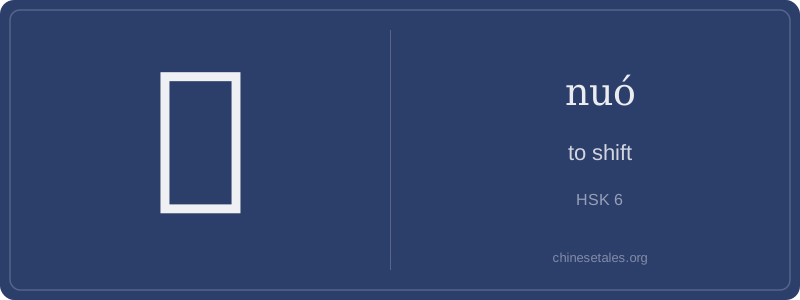
The earliest form of 挪 appears in seal script (c. 3rd century BCE), built from 扌 (hand radical) on the left and 那 (nà, ‘that’) on the right. The hand radical is clear — this is an action done by hands. But 那 wasn’t just a phonetic placeholder: in ancient usage, 那 carried a sense of ‘that place over there’, implying directionality and distance. So visually, 挪 was literally ‘hand-action toward that place’ — a graphic blueprint for ‘shifting something from here to there’. Over centuries, the right side simplified from the full 那 (which itself evolved from a pictograph of a person turning their head to point) into today’s streamlined shape, while the hand radical remained unmistakably active.
This spatial logic deepened in classical usage: in texts like the *Mencius*, 挪 appears in descriptions of adjusting ritual objects — moving a sacrificial vessel just so to maintain cosmic harmony. By the Ming and Qing dynasties, 挪 acquired its modern financial nuance: shifting money between accounts became a common bureaucratic act — and also a frequent cover for corruption, cementing 挪用 as a legal term. The character’s visual quietness (just nine strokes!) belies its heavy cultural weight: it’s the calm hand that moves both furniture and fortunes.
At its heart, 挪 (nuó) is about *controlled displacement* — not forceful moving like 推 (tuī, 'to push') or dragging like 拉 (lā), but the careful, often reluctant, shifting of something from one place to another: a chair, funds, responsibility, even time. It carries a subtle sense of adjustment, reallocation, or making room — always with human agency and intention. Think of it as the linguistic equivalent of gently nudging a bookshelf sideways to fit a new sofa.
Grammatically, 挪 is almost always transitive and requires an object — you *挪* something. It frequently appears in compound verbs (挪动, 挪用) or with directional complements (挪开, 挪到…). A classic HSK 6 trap? Using 挪 when you mean ‘to move’ in a general physical sense — e.g., ‘I moved the table’ sounds odd as 我挪了桌子; better is 我搬了桌子 (bān, ‘to carry/move furniture’) or even just 我移了桌子 (yí, more neutral ‘to shift’). 挪 implies purposeful repositioning, often with effort or consequence.
Culturally, 挪 often appears in sensitive contexts — especially 挪用 (nuóyòng), meaning ‘to misappropriate’ (e.g., funds). This isn’t accidental: the character’s very structure hints at hand-driven action applied to something that *shouldn’t be moved*. Learners sometimes overuse it after learning ‘shift’ as a translation, missing its connotation of cautious, sometimes ethically loaded, relocation — like shifting blame or relocating budget lines mid-year.