捧
Character Story & Explanation
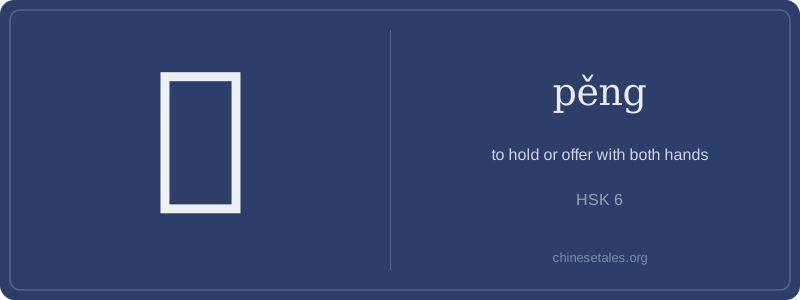
The earliest form of 捧 appears in Warring States bamboo slips as a hand radical plus two parallel horizontal strokes representing paired hands cradling something — perhaps a ritual vessel or jade. Over time, those lines evolved into the phonetic component 朋 (originally picturing two shells, symbolizing mutual value and exchange), while the hand radical solidified as 扌. By the Han dynasty, the structure stabilized: 11 strokes precisely capturing the bilateral gesture — three strokes for the hand radical (㇐㇑㇓), eight for 朋 (two horizontal strokes on top, then two 'moon'-like enclosures side-by-side).
This visual logic directly shaped its semantic journey. In the Classic of Rites, 捧 describes how ministers presented documents to the sovereign — palms upward, elbows bent at 90°, a posture echoing ancestral veneration. Later, in Tang poetry, it extended metaphorically: Li Bai wrote of ‘捧心’ (pěng xīn, 'holding one’s heart') to express raw sincerity. Even today, the stroke order enforces mindfulness — you literally trace both hands moving in unison, reinforcing the character’s core idea: unity of intent and action.
At its heart, 捧 is about reverence and intention — not just 'holding', but holding *with both hands*, like offering a gift to an elder or receiving a diploma. That dual-hand gesture is baked into the character: the left side 扌 (hand radical) signals action, while the right side 朋 (péng, originally meaning 'friends sharing a common purpose') subtly echoes symmetry and reciprocity — two hands moving as one unit. This isn’t casual handling; it’s ceremonial, respectful, even emotionally charged.
Grammatically, 捧 is usually transitive and often appears in formal or literary contexts: 捧着 (pěng zhe, 'holding steadily'), 捧起 (pěng qǐ, 'to lift up with reverence'), or 捧场 (pěng chǎng, 'to support an event/performer'). Unlike generic verbs like 拿 (ná, 'to take/handle'), 捧 implies weight — physical, symbolic, or emotional. Learners often overuse it for everyday actions ('I捧 my coffee'), but native speakers reserve it for moments that carry dignity, gratitude, or gravity.
Culturally, 捧 carries layered nuance: it can signal sincere admiration (捧红, 'to launch someone to fame'), but also ironic or critical flattery (捧杀, 'to praise to death' — i.e., excessive hype that backfires). A classic HSK 6 trap? Confusing 捧 with mere physical contact — remember: if you’re not *intentionally honoring* the object or person, you’re probably using the wrong verb.