掰
Character Story & Explanation
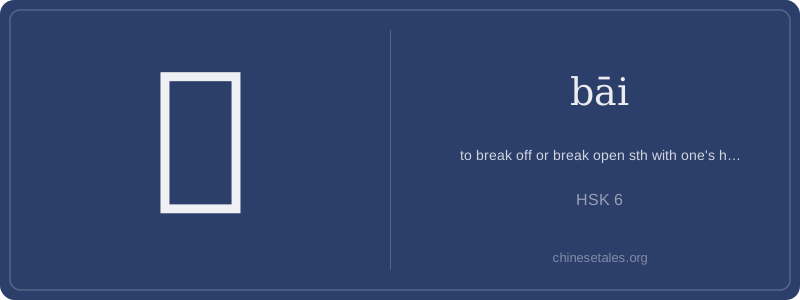
The earliest form of 掰 appears in bronze inscriptions as a vivid pictograph: two hands ( + ) flanking a central object — originally a stylized grain stalk or split kernel (represented by the top component 卝, a variant of 十 or 卐-like symmetry signifying division). Over time, the two hands fused into the left-hand radical 扌 (a cursive simplification of 手), while the top evolved into the symmetrical 卝 → 分 structure (‘to divide’), and the bottom stabilized as the hand-acting-on-object element — giving us today’s 12-stroke layout: 扌 + 分 + 手. Every stroke echoes duality and effort.
By the Han dynasty, 掰 appeared in texts like the *Shuōwén Jiězì* as ‘to separate by hand’, emphasizing manual agency over fate or tool-use. In Ming-Qing vernacular fiction, it frequently describes food preparation (‘bāi jīng bāo’ — tear open a steamed bun) or rustic labor (‘bāi kū zhī’ — break off dry branches). Its visual symmetry — mirrored hands pulling apart — mirrors its semantic core: balance, tension, and release. Even now, when you write 掰, your hand instinctively mimics the motion: left stroke down, right stroke up — a tiny kinetic echo of the act itself.
At its core, 掰 (bāi) isn’t just ‘to break’ — it’s *hand-powered separation*: the visceral, tactile act of prying apart something resistant with both hands, like cracking open a stubborn walnut, tearing a steamed bun in half, or wrenching a branch from a tree. It implies effort, duality (two hands), and physical immediacy — you won’t use 掰 for abstract ‘breaking’ (like breaking a promise) or passive breaking (like glass shattering). That’s why it feels earthy, bodily, almost agricultural: it’s the sound of knuckles popping, not a digital click.
Grammatically, 掰 is almost always transitive and action-oriented. You’ll see it in serial verb constructions (e.g., 掰开 — ‘break open’) or as the main verb in imperative or descriptive contexts (‘Don’t just stare — 掰 it!’). Learners often mistakenly use it where 分开 (fēn kāi, ‘separate’) or 折 (zhé, ‘snap/bend’) would fit better — but 掰 insists on *manual, bilateral force*. It rarely appears in formal writing or passive voice; it belongs in kitchens, markets, and childhood memories.
Culturally, 掰 embodies Chinese pragmatism and embodied cognition: meaning arises from doing, not just thinking. There’s no ‘break’ without the hands — no abstraction without the body. A common mistake? Using 掰 for ‘break up’ a relationship (wrong! Use 分手). Also, 掰 is almost never reduplicated (unlike 拍拍 or 看看) — its very shape resists lightness. It’s a word that *grunts*.