揭
Character Story & Explanation
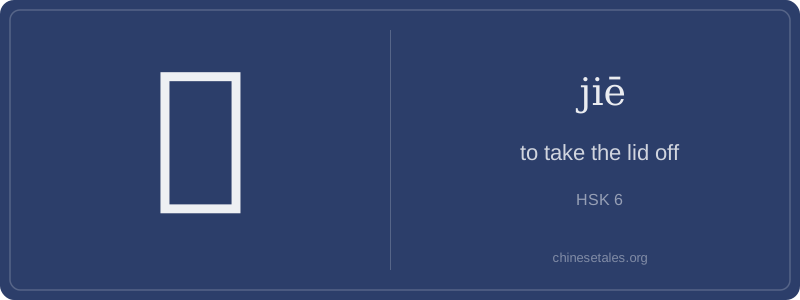
The earliest form of 揭 appears in bronze inscriptions as a compound: 手 (hand) on the left, and 契 (qì, 'carved inscription' or 'tally') on the right—depicting a hand lifting or prying apart wooden tally sticks used in ancient contracts. Over centuries, 契 simplified into 曷 (hé), a phonetic component that also carried connotations of 'questioning' or 'seeking truth'. The modern shape retains the hand radical 扌 on the left, while the right side evolved into 曷 — twelve strokes total, each echoing the motion of peeling back layers: first the hand’s grip, then the upward lift, then the final release of what was bound.
By the Han dynasty, 揭 had shifted from literal 'prying apart tallies' to metaphorical 'laying bare': Sima Qian used 揭 in the *Records of the Grand Historian* to describe exposing corrupt officials. Its visual structure—hand + 'what?/how?'—reinforces its semantic core: an intentional act of inquiry made visible. Even today, the character feels performative: 揭 isn’t quiet revelation—it’s the sharp, public *rip* of a curtain before the truth steps onto stage.
Think of 揭 (jiē) as the Chinese equivalent of 'lifting the veil'—not just physically removing a lid, but dramatically revealing hidden truth. In English, we say 'unmask', 'expose', or 'bring to light'; in Chinese, 揭 is the go-to verb when something concealed—be it a secret, a scam, or even a literal poster—is pulled away with decisive action. It carries weight and intention: you don’t ‘accidentally’ 揭 something—you do it deliberately, often publicly.
Grammatically, 揭 is almost always transitive and pairs naturally with objects like 秘密 (mìmì, 'secret'), 真相 (zhēnxiàng, 'truth'), or 海报 (hǎibào, 'poster'). It frequently appears in the pattern 揭 + noun + (了), e.g., 揭开了谜底 (jiē kāi le mí dǐ, 'revealed the answer'). Unlike more neutral verbs like 显示 (xiǎnshì, 'to display') or 表明 (biǎomíng, 'to indicate'), 揭 implies prior concealment—and often moral urgency.
Culturally, 揭 shows up everywhere from investigative journalism headlines ('揭黑幕', 'expose dark curtains') to classical poetry (e.g., Du Fu’s line 揭我屋上三重茅, describing wind tearing off roof thatch). Learners often overuse it for simple 'showing' or 'opening'—but 揭 isn’t for opening doors or presenting slides. That’s 开 (kāi) or 展示 (zhǎnshì). Using 揭 there sounds oddly dramatic—like announcing a scandal every time you open PowerPoint.