搏
Character Story & Explanation
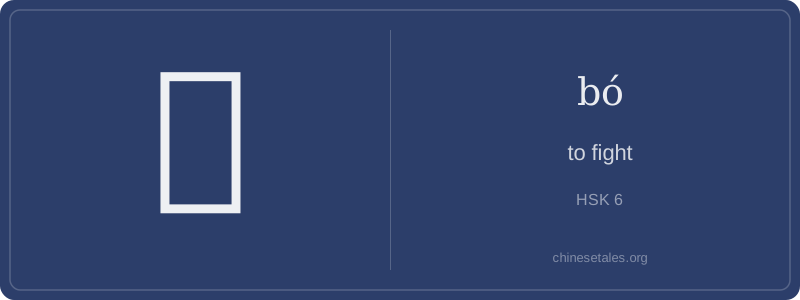
The earliest form of 搏 appears in bronze inscriptions around 1000 BCE: a hand (扌) gripping what looks like a coiled rope or a sinewy animal limb — some scholars read it as a hand seizing a fleeing deer’s leg, others as wrestling a bull’s horn. The right side, originally 博 (bó, ‘to gamble’ or ‘extensive’), was added later for phonetic support, but it’s no coincidence: ancient Chinese saw grappling as both a test of strength *and* a high-stakes contest — like betting your honor on the outcome. Over centuries, the hand radical solidified at left, the ‘coiled limb’ simplified into 专 (zhuān), then further stylized into the modern 专-like shape under 十, and the phonetic 博 was streamlined into today’s 专 + 十 + 口 structure — all 13 strokes now encode both action and risk.
By the Warring States period, 搏 appears in texts like the Zhuangzi, describing sages who ‘搏天地之气’ — not fighting nature, but *engaging it directly*, like a martial artist harmonizing with momentum. This dual sense — physical combat and existential striving — stuck. In Tang poetry, poets wrote of ‘搏云而上’ (bó yún ér shàng, ‘grappling with clouds to ascend’), turning the character into a metaphor for ambition so fierce it defies gravity. Its visual weight — the hand thrusting forward, the dense right side pressing down — mirrors this tension between effort and resistance, making it one of Chinese’s most kinetic ideographs.
At its heart, 搏 (bó) isn’t just ‘to fight’ — it’s *to grapple with force*, to exert full physical or metaphorical effort in a tense, dynamic struggle. Think less ‘punching a bag’ and more ‘wrestling a runaway horse’ or ‘fighting your way through a bureaucratic maze’. It implies intensity, resistance, and bodily engagement — you can 搏斗 (bó dòu) with an opponent, but you can also 搏击 (bó jī) the waves, or even 搏取 (bó qǔ) favor — where the ‘fight’ is strategic, not violent.
Grammatically, 搏 rarely stands alone as a verb in modern speech — it almost always appears in two-syllable compounds (like 搏斗, 搏击, 搏取). You won’t say ‘I bó him’; you’ll say ‘I bó-dòu with him’ or ‘she bó-qǔ his trust’. That’s why learners stumble: they try to use it like English ‘fight’ (a free-standing verb), but Chinese treats it as a *bound morpheme* — a powerful root that needs a partner to function. Also, note: it’s almost never used for verbal arguments (that’s 争 zhēng or 争论 zhēng lùn); 搏 is visceral, kinetic, and often life- or status-adjacent.
Culturally, 搏 carries a quiet dignity — it’s not rage, but *resolute striving*. In martial arts contexts (e.g., 散打 sǎn dǎ, ‘free fighting’), 搏击 means ‘striking combat’, evoking discipline, not chaos. Learners sometimes overuse it trying to sound literary, but native speakers reserve it for moments of high stakes or poetic gravity — like a journalist writing ‘the city搏 against decay’ (城市搏击衰败). Its tone (bó, second tone) even rises like a surge of energy — a sonic echo of its meaning.