撇
Character Story & Explanation
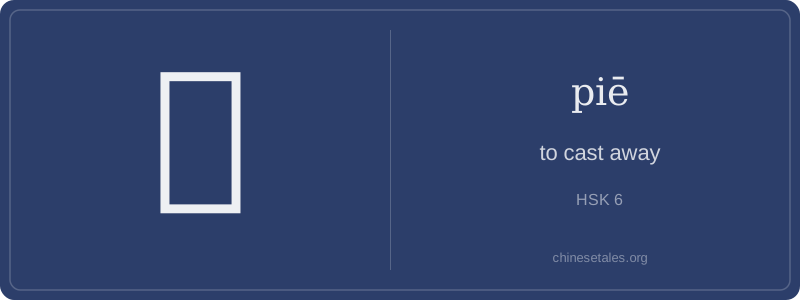
The earliest form of 撇 appears in bronze inscriptions as a hand (手) gripping a curved utensil — likely a ritual ladle (匕) used to scoop and pour offerings. Over centuries, the hand simplified into the 扌 radical, while the ladle morphed into the distinctive slanted stroke we see today: that long, sharp, descending left-flick (the 'pie' stroke itself!) isn’t just calligraphic flair — it’s the visual echo of the wrist’s outward, flicking motion used to cast liquid or grain away. By the Han dynasty, the character stabilized into its current 14-stroke structure, preserving both the manual agency (扌) and the directional force (匕 + the extended diagonal).
This kinetic origin shaped its semantic evolution: from literal scooping-and-discarding in sacrificial rites, 撇 broadened in classical texts to mean 'rejecting worldly attachments' — Confucius praised those who could 撇浮名 (discard superficial fame). In Tang poetry, it described swords flashing sideways in battle; by Ming fiction, it captured emotional gestures like 撇嘴 (pouting) or 撇手 (waving off dismissively). Even today, the character’s shape mirrors its function: that decisive, downward-left stroke *is* the act of casting away — a glyph that moves as it means.
At its core, 撇 (piē) is a vivid verb meaning 'to cast away,' 'to fling aside,' or 'to discard with deliberate force' — not just dropping something, but doing so with a flick of the wrist, a dismissive motion, or even emotional finality. Its radical 扌 (hand) immediately signals bodily action, while the right side 匕 (bǐ) — originally a spoon or ladle in ancient script — evolved to suggest a swift, outward, sweeping motion, like scooping and tossing something off-stage. Think of a chef flicking excess water from herbs, or a diplomat brushing off an insult: it’s physical, intentional, and often loaded with attitude.
Grammatically, 撇 is almost always transitive and frequently appears in literary or formal registers — you’ll rarely hear it in casual chat. It pairs strongly with abstract nouns: 撇开 (piēkāi, 'set aside' a problem), 撇下 (piēxià, 'abandon' someone or something), or 撇清 (piēqīng, 'disassociate oneself from'). Note: learners often mistakenly use it where 推 (tuī, 'push') or 放弃 (fàngqì, 'give up') would be more natural; 撇 implies *sudden, visible, almost theatrical* removal — not gradual withdrawal. Also, watch the tone: piē (first tone) is the main HSK 6 reading for 'cast away'; piě (third tone) appears only in rare compound words like 撇嘴 (piě zuǐ, 'to pout'), where it mimics the mouth’s downward flick.
Culturally, 撇 carries subtle connotations of moral or social detachment — think of classical texts where sages 'cast aside' fame or desire (如《庄子》中‘撇却功名’). Modern usage retains that weight: 撇下父母 sounds far harsher than 离开父母. A common mistake? Overusing it in speech — native speakers prefer softer verbs like 放下 or 不理 in daily talk. Save 撇 for writing, drama, or when you want to land a rhetorical punch.