挠
Character Story & Explanation
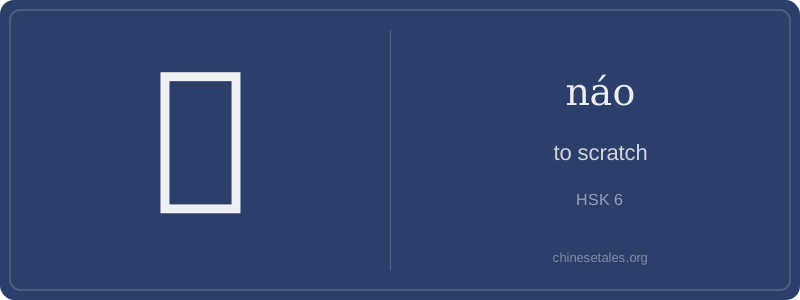
The earliest form of 挠 appears in Warring States bamboo texts as a composite: left side 扌 (hand radical), right side 尧 — which originally depicted a person with raised arms and a prominent head (a pictograph of a ‘lofty’ or ‘exalted’ figure, later borrowed phonetically). In seal script, 尧’s three horizontal strokes stacked high evoked height or agitation — fitting, since scratching often stems from restless energy. Over centuries, the hand radical standardized into 扌, while 尧 simplified: its top dot fused with the first horizontal, and the lower ‘X’-shaped component (兀) condensed into the modern four-stroke ‘nao’ shape. The nine strokes today — three for 扌, six for 尧 — preserve this ancient balance of action and cause.
By the Han dynasty, 挠 appeared in the Shuōwén Jiězì as ‘to disturb, to unsettle’, rooted in the idea of a hand disrupting calm — whether by scratching skin or stirring emotions. Its physical sense (scratching) became dominant in vernacular usage by the Ming-Qing period, especially in novels like Jin Ping Mei, where characters ‘náo le yí xià tóu’ before lying — linking gesture to inner turmoil. Even today, the character visually whispers its dual nature: the hand (action) pressing against something elevated (尧), suggesting both surface contact and psychological friction.
Imagine you’re in a Beijing teahouse on a sweltering summer afternoon — sweat prickles your neck, and an insistent itch crawls up your forearm. You raise your hand instinctively, fingers curling, nails lightly dragging across skin: náo. That’s 挠 — not just ‘to scratch’ as a neutral verb, but a tactile, almost visceral action: quick, localized, often involuntary, sometimes nervous or irritated. It’s the soundless scrape of a fingernail, the fidgety rub behind the ear before answering a tough question — never used for broad, sweeping motions (that’s 刮 or 擦).
Grammatically, 挠 is usually transitive and pairs naturally with body parts (挠头, 挠痒, 挠耳朵) or abstract nouns like 痒 (itch), 心 (heart/mind), or even 静 (calm). You’ll hear it in reflexive structures (tā zìjǐ náo le yí xià tóu) or causative contexts (bèi mǎ yǎo le, tǎng zài chuáng shàng zhí jiē náo de shuì bù zháo). Crucially, it’s rarely used in formal writing without context — saying ‘I scratched’ alone feels incomplete; Chinese expects *what* or *where* was scratched.
Culturally, 挠 carries subtle psychological weight: 挠心 means ‘to gnaw at one’s mind’ — not anger, but low-grade, persistent anxiety. Learners often overgeneralize it to mean ‘touch’ or ‘rub’, or mistakenly use it for scratching surfaces (e.g., furniture) — that’s 刮 or 划. Also, don’t confuse its tone: náo (2nd tone) ≠ nǎo (3rd tone, ‘to annoy’) — though they’re etymologically linked, they’re distinct words now.