擅
Character Story & Explanation
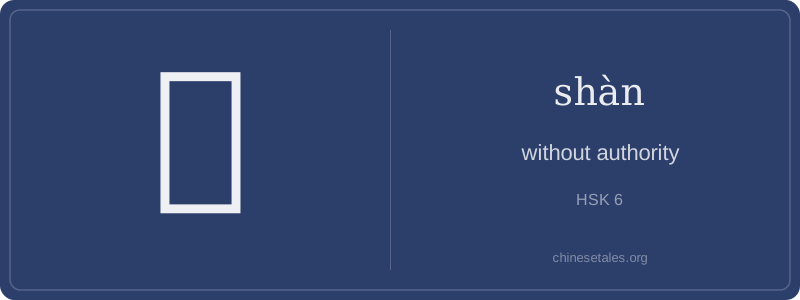
The earliest form of 擅 appears in bronze inscriptions as a hand (扌) gripping a stylized ‘arrow’ or ‘dart’ shape — now the right-hand component, which evolved from the ancient character 婴 (yīng), originally depicting a baby wrapped in swaddling clothes, later borrowed phonetically. Over centuries, the left side solidified as the hand radical 扌 (indicating action), while the right side simplified from 嬰 to 亶 (dǎn), a phonetic component meaning ‘sincere’ or ‘abundant’ — but here serving purely for sound. By the Han dynasty, the modern structure emerged: 16 strokes, with the hand radical anchoring the meaning of *doing*, and 亶 lending the shàn pronunciation.
This visual duality — hand + ‘abundant/sincere’ — subtly reinforced the semantic shift: doing something *so well* it feels abundant, sincere, natural — yet still outside formal bounds. In classical texts like the Zuo Zhuan, 擅 appears in phrases like 擅专 (shàn zhuān), meaning ‘to monopolize authority unlawfully’, highlighting its early association with overreach by officials. Its evolution mirrors China’s bureaucratic history: as imperial administration grew, so did linguistic precision around authorized vs. de facto power — making 擅 a quiet lexical witness to 2,500 years of governance tension.
At its heart, 擅 (shàn) isn’t just about ‘without authority’ — it’s about the quiet tension between competence and permission in Chinese social logic. It describes actions performed *well* but *without proper sanction*: someone who excels at something they’re not officially supposed to do. That nuance is crucial: it’s not incompetence (that’s 失败), nor rebellion for its own sake (that’s 叛), but a subtle, often admired, overstepping — like a junior engineer fixing a critical bug without approval. The character carries a faintly admiring, slightly nervous tone: 'impressive… but please don’t tell the boss.'
Grammatically, 擅 almost always appears in the pattern 擅长 (shànzhǎng) — ‘to be skilled at’ — where 长 means ‘long’ or ‘proficient’, turning the whole compound into a fixed verb meaning ‘to excel in’. Crucially, 擅 *never stands alone* as a verb in modern Mandarin; you’ll never say ‘他擅编程’ — it must be 擅长编程. Learners often mistakenly treat it like a standalone verb (like 爱 or 吃), leading to ungrammatical sentences. Also, note: 擅 is exclusively used in formal or written contexts — you won’t hear it in casual chat; instead, people say 会 (huì) or 比较厉害 (bǐjiào lìhai).
Culturally, this reflects deep-rooted Confucian values: skill matters, but *proper role and authorization matter more*. To 擅长 something implies both ability *and* awareness of hierarchy — the speaker acknowledges the person’s talent while quietly noting the boundary crossed. A common mistake is confusing 擅 with 善 (shàn, ‘good/at’) — they sound identical and share etymological roots, but 善 is moral goodness or general proficiency (e.g., 善于), while 擅 is specifically *unauthorized excellence*, carrying that extra layer of institutional awareness.