攀
Character Story & Explanation
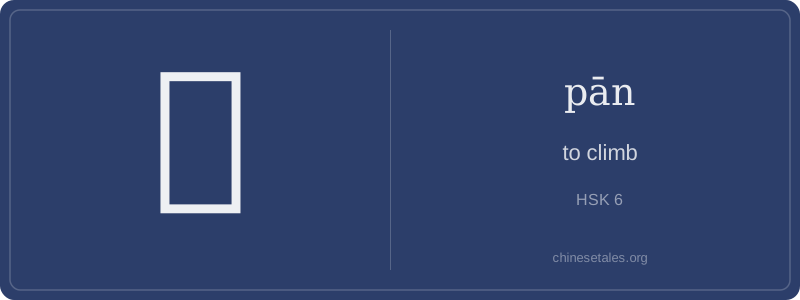
The earliest form of 攀 appears in bronze inscriptions as a vivid pictograph: two interlocking hands ( + ) gripping a tree (木), with dangling vines or branches (two sets of ‘X’-like strokes) wrapping around them — literally ‘hands clutching a tree’. Over time, the tree became simplified into 木, the hands evolved into the left-hand radical 扌 (a variant of 手), and the top gained two ‘X’ shapes (represented by the double ‘乂’ in modern form) symbolizing entwined limbs or grasping motion. The lower part stabilized into 大 (a person with outstretched arms) and 两 (liǎng, originally ‘two’ but here reinforcing duality — two hands, two arms, two efforts).
This visual narrative of struggle and ascent shaped its semantic evolution: in the *Shuōwén Jiězì* (121 CE), it’s defined as ‘to pull oneself up with hands and feet’, emphasizing full-body engagement. Classical texts like the *Zuo Zhuan* use it for military sieges — ‘climbing city walls’ — underscoring danger and intentionality. Even today, its structure mirrors its meaning: the upper ‘two Xs’ look like crossed arms reaching, the 扌 on the left confirms manual action, and the 大 + 两 below suggest a person straining with dual effort — a perfect visual etymology.
Think of 攀 (pān) as the Chinese equivalent of 'scaling a cliff face' — not just walking up stairs, but grappling, reaching, and pulling yourself upward with hands and will. It’s visceral: you *feel* the strain in your arms and shoulders, which is why its radical 手 (hand) anchors it so firmly. Unlike English ‘climb’, which can be abstract (‘climb the corporate ladder’), 攀 almost always implies physical effort, verticality, and active use of the hands — even when used metaphorically, like 攀高枝 (pān gāo zhī, ‘to climb a high branch’), meaning to marry or ally with someone socially superior.
Grammatically, 攀 is almost never used alone; it’s either part of a compound (攀爬, 攀登) or paired with directional complements (爬上、攀上). Learners often mistakenly say *wǒ pān shān* (I climb mountain) — but that sounds unnatural without a complement or object marker; instead, it’s *wǒ pān shàng le shān* (I climbed up onto the mountain) or *wǒ qù pān shān* (I’m going to climb the mountain). Also, it’s rarely used for gentle slopes — for those, 爬 (pá) or 登 (dēng) are more common.
Culturally, 攀 carries subtle judgment: 攀比 (pān bǐ, ‘keeping up with the Joneses’) reflects deep-rooted social comparison, while 攀亲 (pān qīn, ‘claiming kinship’) hints at opportunistic networking. A classic learner trap? Using 攀 where 爬 fits better — e.g., *pān tīzi* for ‘climbing a ladder’ sounds overly dramatic; 爬梯子 is natural and neutral. Remember: 攀 is for Everest, not your bookshelf.