搀
Character Story & Explanation
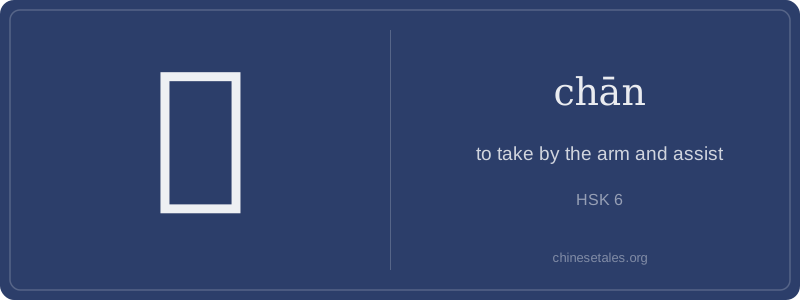
The earliest form of 搀 appears in seal script (c. 3rd century BCE), where it combines 扌 (hand radical) on the left with 参 (cān) on the right — not the modern simplified 又+厶, but a more complex shape depicting three stars (彡) beneath a person (厽), symbolizing observation, participation, or involvement. Over centuries, 参 simplified dramatically: the three-star motif shrank to 厶, and the top stroke merged, yielding today’s 参-like right side. Crucially, the hand radical has remained front-and-center — a visual promise that this character is about action, contact, and agency.
This evolution mirrors meaning refinement: early texts like the *Shuōwén Jiězì* (121 CE) defined it as 'assisting with hands', emphasizing manual guidance. By the Tang dynasty, 搀 appears in poetry describing monks 搀着病僧下山 — a tender, grounded act of compassion. Its stability across 2,000 years is rare: while many characters shifted from concrete to abstract meanings, 搀 stayed stubbornly physical, resisting metaphorical drift. Even today, if you see 搀 in classical-style prose, it still means fingers wrapped gently around an elbow — no digital 'assistance', no bureaucratic 'support'.
At its heart, 搀 (chān) is about gentle, physical support — specifically, guiding someone by the arm: helping an elder cross a street, steadying a child on icy steps, or assisting a patient to stand. It’s not just ‘help’ in the abstract; it’s tactile, intimate, and implies vulnerability on one side and responsibility on the other. The character radiates warmth but also quiet authority — you wouldn’t 搀 a CEO into a boardroom, but you absolutely would 搀 your grandmother onto a bus.
Grammatically, 搀 is almost always transitive and takes a human direct object (e.g., 搀他, 搀老人). It rarely appears alone — you’ll see it in verb-complement structures like 搀扶 (chānfú, 'to support physically') or as part of descriptive phrases like 搀着胳膊 (chān zhe gēbo, 'holding [someone] by the arm'). Learners often mistakenly use it for non-physical help — say, 'I helped him with his homework' — but that’s 帮助 or 辅导, not 搀. Also, it never takes 了 or 过 without a complement: *我搀了 isn’t complete; you need 我搀了他一把 or 我搀着他走了几步.
Culturally, 搀 carries subtle Confucian weight: it’s a quiet performance of filial piety (xiào) and social care. In literature and film, a character 搀着 someone often signals emotional turning points — think of a son finally 搀起 his estranged father after years of silence. A common error? Overusing it in formal writing where neutral verbs like 扶 or 协助 fit better. And yes — tone matters: chān (first tone) sounds firm and steady, unlike the rising chǎn (third tone), which means 'to excavate' and shares no semantic link.