斟
Character Story & Explanation
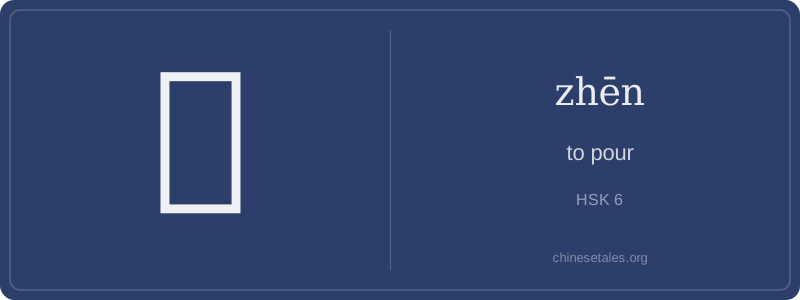
The earliest form of 斟 appears in bronze inscriptions as a composite pictograph: on the left, a hand (扌, later simplified to 才) reaching toward a vessel — specifically the ancient measuring cup 斗 (dǒu), which gives this character its radical. On the right, a phonetic component 甚 (shèn, ‘very, exceedingly’) was added early on for sound — though its semantic weight also subtly reinforced the idea of ‘doing thoroughly’. Over centuries, the hand morphed into the modern 扌 radical, the 斗 retained its shape as the rightmost component, and the 甚 simplified and fused, losing its top strokes to become today’s 甚-like upper portion — all 13 strokes now encoding both action (pouring) and care (‘very’ + vessel).
This visual logic shaped its meaning evolution: from concrete ‘measuring and pouring wine into cups’ in Zhou dynasty banquets (recorded in the *Book of Rites*) to the classical metaphor of ‘weighing words before speaking’. Confucius praised gentlemen who ‘斟酌而行’ — pouring only what is fitting, sipping only what is wise. By the Tang dynasty, poets like Li Bai used 斟 to evoke intimacy and elegance: ‘举杯邀明月,对影成三人’ (raising a cup he’d just 斟) — the act itself becoming a bridge between human and cosmos. Even today, when you see 斟, you’re seeing 3,000 years of mindful hospitality frozen in ink.
At its heart, 斟 isn’t just ‘to pour’ — it’s the quiet ceremony of intentionality. Unlike generic verbs like 倒 (dào, 'to pour out'), 斟 carries a sense of care, precision, and respect: you 斟 wine for a guest, not just dump it; you 斟 tea with mindfulness, not haste. It implies control — the wrist steady, the stream measured, the vessel held at just the right angle. This reflects a deep cultural value: that how something is done matters as much as what is done.
Grammatically, 斟 is almost always transitive and requires an object (e.g., 斟酒, 斟茶). It rarely stands alone — you won’t say *‘I’m 斟ing’* without specifying *what* you’re pouring. Learners often mistakenly use it for casual actions (like pouring water from a tap), but native speakers reserve it for deliberate, often ritualized or hospitable acts — especially with alcohol, tea, or metaphorical substances like wisdom or advice (e.g., 斟酌). That last usage is key: in formal writing, 斟 is nearly always paired with 酌 in 斟酌 (zhēn zhuó), meaning ‘to weigh carefully’, literally ‘to pour and sip thoughtfully’.
A common pitfall? Overusing 斟 where 倒 fits better — it sounds oddly poetic or stiff in mundane contexts. Also, note its tone: zhēn (first tone), not zhěn — mispronouncing it as ‘zhen’ with third tone accidentally evokes the unrelated character 斟 (a rare variant) or worse, confuses listeners with 真 (zhēn, ‘true’) or 诊 (zhěn, ‘diagnose’). The character whispers refinement — so treat it like fine porcelain: handle with attention.