休
Character Story & Explanation
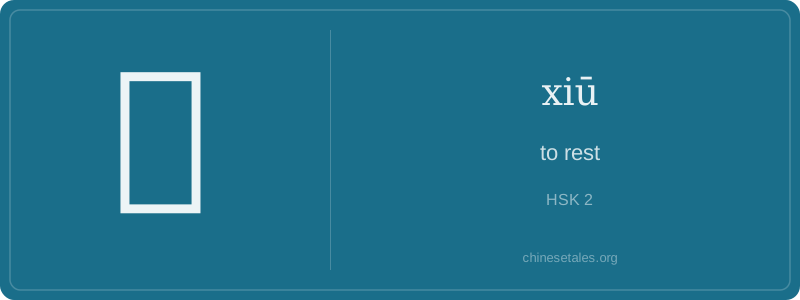
The earliest form of 休, carved on oracle bones over 3,000 years ago, was a vivid pictograph: a person (亻) leaning against a tree (木). You could almost feel the warmth of bark and the relief of weight lifted — no abstract idea, just embodied respite. Over centuries, the tree simplified from a full trunk-and-branches (木) into today’s top stroke + two diagonal lines, while the person shrank to the left-side radical 亻. By the seal script era, the structure was locked in: human + tree = rest. Even now, those six strokes whisper: *‘Here, lean.’*
This visual logic never faded — in the Analects, Confucius praises rulers who ‘rest the people’ (安民以休 ān mín yǐ xiū), linking rest to benevolent governance. The character’s shape remained so transparent that even Tang dynasty poets used 休 metaphorically: ‘The war has rested’ meant peace had settled, like a traveler finally pausing under shade. That ancient tree still stands — not as wood, but as wisdom: true rest isn’t idle; it’s rooted, intentional, and deeply human.
At its heart, 休 (xiū) isn’t just ‘to rest’ — it’s the quiet sigh after effort, the deliberate pause that restores balance. Think of it as *active stillness*: stepping back to breathe, not collapsing from exhaustion. Unlike verbs like 睡 (shuì, 'to sleep'), which implies unconsciousness, 休 carries intention and dignity — you choose to rest, and in Chinese culture, that choice is respected as wise stewardship of energy.
Grammatically, 休 is wonderfully flexible at HSK 2. It works as a verb ('I’ll rest now': 我要休息了 wǒ yào xiūxi le), as part of the common compound 休息 (xiūxi), and even as an imperative ('Rest!': 休息一下 xiūxi yíxià). A frequent learner trap? Using 休 alone without context — e.g., saying *‘我休’* sounds abrupt or even archaic (like saying 'I repose!' in English). Stick with 休息 or add particles like 了 or 一下 for natural flow.
Culturally, 休 appears in foundational concepts like 休假 (xiūjià, 'vacation') and 退休 (tuìxiū, 'retirement') — both implying earned transition, not escape. Note: while 休 can mean 'to stop' (e.g., 休学 xiūxué, 'to suspend studies'), this sense leans formal or bureaucratic; for everyday 'stop doing something', use 停 (tíng) or 别 (bié). Also — don’t confuse its calm vibe with laziness: in classical texts, 休 often signals harmony restored, like heaven and humanity coming into alignment.