斯
Character Story & Explanation
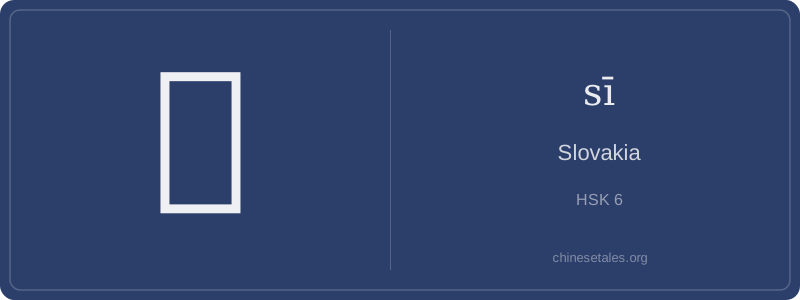
The earliest form of 斯 appears in Warring States bamboo slips — not as a pictograph, but as a phonosemantic compound. Its left side, 斤 (jīn), was originally an axe radical, but here it’s purely phonetic, hinting at the ancient pronunciation *sre*. The right side, 其 (qí, ‘its’), was the semantic component, implying ‘this (very) one’ — a demonstrative force. Over centuries, 其 simplified dramatically: its top ‘rain’ radical (⺮) vanished, its middle ‘basket’ shape collapsed into the three horizontal strokes and dot we see today, while 斤 retained its axe-like structure. By the Han dynasty clerical script, 斯 had stabilized into its current 12-stroke balance: four strokes on the left (斤), eight on the right (the stylized remnant of 其).
In classical texts like the Analects, 斯 carried strong demonstrative weight: ‘斯人也’ (‘This person!’) conveyed immediacy and moral weight — Confucius pointing emphatically, not just naming. But by the Tang dynasty, its standalone use faded, surviving mainly in literary set phrases like ‘斯文’ (sīwén, ‘refined culture’). Its modern revival as a transliteration character is ironic: the ‘this/here’ character now anchors distant places — Slovakia, Sri Lanka, Stockholm — turning ancient deixis into global cartography.
Imagine you’re at a Beijing university café, overhearing two linguistics PhD students debating Slovakia’s role in Central European phonology — and they keep saying ‘Sī luó fá’ with crisp, precise tones. That ‘sī’ isn’t just a soundbite: it’s the official Chinese transliteration character for Slovakia, chosen not for meaning but for phonetic fidelity. 斯 is one of those rare HSK 6 characters that carries *zero* native semantic weight in modern usage — it’s purely a phonogram, a sound placeholder borrowed from classical Chinese, where it once meant ‘this’ or ‘thus’. You’ll never use it alone in speech; it only appears fused in proper nouns like 斯洛伐克 (Sīluòfákè).
Grammatically, 斯 is inert — no verbs, no adjectives, no particles. It doesn’t conjugate, decline, or modify anything. Its sole job is to anchor the ‘si’ syllable in foreign names: 斯里兰卡 (Sīlǐlánkǎ, Sri Lanka), 斯德哥尔摩 (Sīdé gē’ěr mó, Stockholm). Learners often mistakenly try to parse it as a meaningful morpheme — e.g., thinking 斯洛伐克 means ‘Slovakia-land’ — but no: it’s just syllabic scaffolding. Drop the 斯, and you lose the ‘si’ sound entirely.
Culturally, this reflects China’s meticulous, historically layered approach to transliteration: early Buddhist texts used 斯 for Sanskrit ‘śi’ (as in 斯陀含, Sītuóhán, a stage of enlightenment), later repurposed for European ‘S-’ names. A common error? Confusing 斯 with 思 (sī, ‘to think’) — writing ‘I think about Slovakia’ as ‘我思洛伐克’ instead of ‘我想念斯洛伐克’. The former reads as ‘I think-Luo-fa-ke’, nonsensical and unintentionally Zen.