旨
Character Story & Explanation
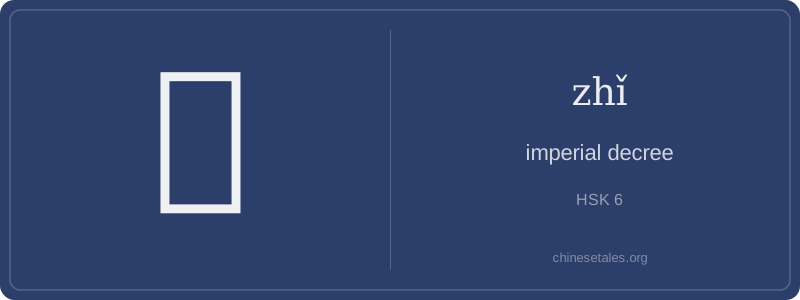
The earliest form of 旨 appears in Shang oracle bone inscriptions as a pictograph combining 日 (rì, ‘sun/day’) at the top and 甘 (gān, ‘sweet/delicious’) below—a stylized depiction of sacrificial food offered at sunrise to ancestors or deities. Over centuries, 甘 simplified: its top two horizontal strokes merged into one, and the central vertical stroke extended upward to meet the 日, yielding the modern six-stroke structure. The radical 日 wasn’t merely decorative—it anchored the character in ritual time: decrees were issued at auspicious daylight hours, aligning human command with celestial order.
This ritual origin explains why 旨 evolved from ‘sacrificial offering’ → ‘intention behind the offering’ → ‘sovereign intention’ → ‘imperial decree.’ In the *Book of Documents* (*Shūjīng*), phrases like ‘王曰:旨哉!’ (The King said: ‘How profound!’) show its early use for ‘profoundly meaningful intent’—a semantic bridge between ritual sincerity and political authority. Its visual compactness (just six strokes!) belies its immense semantic heft: a tiny sun overseeing a distilled essence of will.
Imagine a hushed imperial court during the Tang Dynasty: a eunuch unrolls a silk scroll, and the assembled ministers bow low—not to the scroll itself, but to the single, potent character at its top: 旨. That’s not just ‘decree’—it’s *the* decree: the emperor’s will made visible, absolute, and non-negotiable. In modern Chinese, 旨 retains that aura of solemn authority, though it’s now mostly literary or bureaucratic. You’ll rarely hear it in casual speech—but you *will* see it in formal documents, historical dramas, and academic writing about classical governance.
Grammatically, 旨 functions as a noun (e.g., 圣旨 shèngzhǐ, 'imperial edict') or occasionally as a verb meaning 'to decree' (archaic). Crucially, it almost never stands alone—it’s always embedded in compounds or preceded by modifiers like 圣 (sacred), 御 (imperial), or 宗 (ancestral). Learners often mistakenly use it like the neutral word 指令 (zhǐlìng, 'instruction')—but 旨 carries sacred weight; saying ‘老板的旨’ (boss’s decree) would sound hilariously overblown, like calling your manager ‘His Imperial Majesty.’
Culturally, 旨 reflects China’s deep-rooted hierarchy: language itself was calibrated to mirror cosmic order. Even today, when officials issue ‘重要批示’ (important instructions), the echo of 旨 lingers—not in sound, but in gravity. A common error? Confusing it with 指 (zhǐ, ‘to point’) due to similar pronunciation and stroke count—but 指 is directional; 旨 is sovereign.