旺
Character Story & Explanation
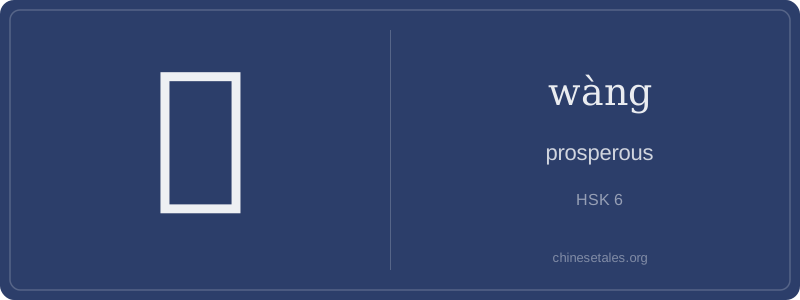
The earliest form of 旺 appears in late Warring States bamboo slips — not as a pictograph, but as a phonosemantic compound already. Its left side 日 (sun/day) wasn’t literal daylight, but a semantic anchor for *brightness, vitality, and cyclical renewal*. The right side 王 (wáng, ‘king’) wasn’t about royalty — it served as the phonetic clue (both 旺 and 王 were pronounced *wang* in Old Chinese), while subtly reinforcing *supreme, unchallenged strength*. Over centuries, the strokes simplified: the oracle bone-style sun became the clean square 日, and 王’s three horizontal strokes plus vertical line solidified into today’s crisp four-stroke form — no dots, no hooks, just confident, upright energy.
This visual duality — sun + king — crystallized its meaning: not just ‘rich’, but ‘flourishing under cosmic favor’. By the Han dynasty, 旺 appeared in texts like the *Huainanzi* describing ‘qi that is 旺’ — vital force at its peak. In Ming-Qing vernacular fiction, merchants prayed to Guan Yu for ‘财旺’ (wealth prosperity), linking material success to moral authority (the ‘king’ connotation). Even today, the shape feels like two pillars supporting a radiant roof — a perfect glyph for unstoppable, sunlit ascent.
At its heart, 旺 isn’t just ‘prosperous’ — it’s *vibrantly alive*, like a bonfire crackling with heat and light. The character pulses with upward energy: think booming business, flourishing health, or a family’s fortune surging after generations of quiet struggle. It’s not passive wealth — it’s active, visible, almost audible growth. You’ll hear it in greetings (‘生意兴隆,财源广进!’), see it on red banners during Spring Festival, and feel it in the pride behind ‘我们家今年特别旺!’
Grammatically, 旺 is primarily an adjective — but unlike English, it rarely stands alone. It needs reinforcement: 兴旺, 旺盛, 红火旺, or as part of set phrases like 旺铺 (a thriving shop). Crucially, it *doesn’t* take 了 or 过 to indicate past state — you wouldn’t say ‘他去年很旺’; instead, you’d say ‘他去年生意很旺’ (his business was thriving). Learners often overuse it like ‘successful’, missing its cultural weight: 旺 implies collective, auspicious, *cosmically aligned* prosperity — not just personal achievement.
Culturally, 旺 is deeply tied to qi flow and feng shui: a room with strong sunlight (日 radical!) and good airflow is said to have ‘旺气’ — vital, life-enhancing energy. Mispronouncing it as wāng (like 汪) instantly breaks the vibe — imagine yelling ‘WĀNG!’ at a New Year banquet. Also, avoid pairing it with abstract nouns without support: ‘旺发展’ sounds broken; ‘蓬勃发展’ or ‘发展兴旺’ flows naturally. It’s a word that demands context — like a flame needing oxygen.