昧
Character Story & Explanation
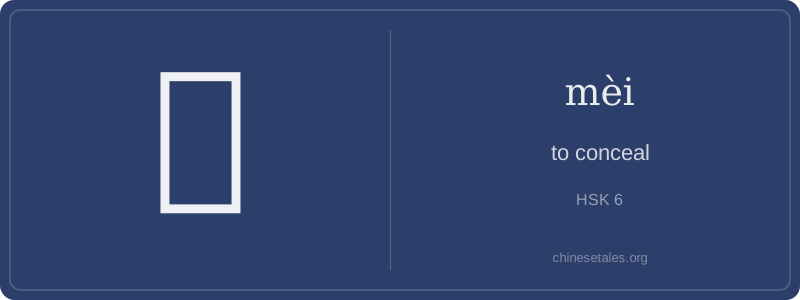
The earliest form of 昧 appears in bronze inscriptions as a combination of 日 (sun) above a simplified depiction of a person (人 rén) with arms crossed or covering the eyes—literally 'a person under the sun, shutting out light.' Over time, the human figure evolved into the component 末 (mò, 'tip/end'), whose top two horizontal strokes resemble closed eyelids, while the bottom stroke anchors it like feet on earth. By the seal script era, the structure solidified: 日 atop 末, totaling nine strokes—each one echoing that original image of conscious occlusion.
This visual logic shaped its semantic journey: from physical shading (e.g., clouds masking sunlight) to metaphorical suppression—hiding truth, concealing guilt, or refusing enlightenment. In the Mencius, the phrase '昧心' (mèi xīn, 'obscure-heart') condemns acting against one’s conscience—a usage still alive today. The character never lost its moral charge: even in modern legal texts, 昧 is used only when concealment implies culpability, never mere secrecy. Its enduring power lies in how the sun radical forces us to confront the irony: light is present, yet denied.
At its heart, 昧 (mèi) is about darkness—not of night, but of willful obscurity: hiding truth, suppressing knowledge, or turning away from clarity. Its radical 日 (rì, 'sun') is deeply ironic: imagine the sun blazing overhead while someone deliberately shuts their eyes or covers a lamp—this character captures that tension between light and deliberate blindness. It’s not passive ignorance (that’s 愚 yú or 蒙 méng); it’s active concealment, often with moral weight—think of officials hiding evidence or scholars suppressing dissenting views.
Grammatically, 昧 appears almost exclusively in literary or formal compounds, rarely as a standalone verb. You’ll see it in verbs like 掩昧 (yǎn mèi, 'to suppress and conceal') or the classical phrase 不明不昧 (bù míng bù mèi, 'neither ignorant nor deceitful'), where it functions as a stative adjective meaning 'deliberately obscure' or 'willfully blind.' Learners often mistakenly use it like a casual synonym for 'hide' (藏 cáng) — but 昧 carries ethical gravity; you don’t 昧 your keys—you might 昧 the facts.
Culturally, this character echoes Confucian and Legalist debates about transparency in governance. In the Book of Documents, rulers are warned against 昧德 (mèi dé, 'concealing virtue')—not withholding goodness, but failing to manifest it publicly. A common learner trap is misreading it as 未 (wèi, 'not yet') due to visual similarity—but while 未 points to time, 昧 points to intention. Its tone (mèi, fourth) also helps: think 'meh?—no, *MAY-uh!*—you’re deliberately ignoring it.'