晋
Character Story & Explanation
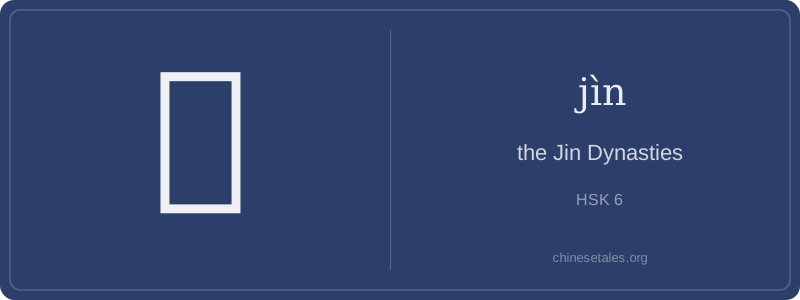
The earliest form of 晋 appears on Western Zhou bronze inscriptions as two hands (爫-like shapes) holding up a sun (日) — not literally the celestial body, but a symbolic disc representing sovereign authority. Over centuries, the hands simplified into the top component (亞 yà, resembling a symmetrical 'H' shape), while the sun remained intact at the bottom. By the Small Seal Script, the character stabilized into its modern structure: 亞 above 日 — ten strokes total, with the radical 日 anchoring its meaning in luminosity and mandate. The visual logic is potent: 'raising the sun' = installing rightful rule, illuminating the realm.
This 'raising-up' imagery directly birthed its verb sense. In the *Zuo Zhuan*, Duke Wen of Jin is praised for ‘晋德’ (jìn dé — 'advancing virtue'), linking dynastic identity with moral ascent. Later, during the Eastern Jin, literati reframed 晋 as cultural continuity itself — surviving chaos not by force, but by refining poetry, calligraphy, and philosophy. So while the character’s shape froze millennia ago, its meaning expanded from concrete enthronement to abstract elevation: of status, of ethics, of art. Even today, when someone says 晋升, they’re invoking that ancient gesture — hands lifting light into position.
At first glance, 晋 (jìn) feels like a quiet historical footnote — just 'the Jin Dynasties' — but in Chinese consciousness, it pulses with layered resonance. It’s not merely a proper noun; it carries the weight of legitimacy, succession, and upward movement: the verb 晋 (to advance, to promote) is still actively used in formal contexts (e.g., 晋升 jìnshēng — 'to be promoted'). This dual identity — dynasty name *and* action verb — reflects how deeply Chinese historiography intertwines political authority with moral progression: to 'advance' isn’t just climbing ranks, but ascending toward virtue and responsibility.
Grammatically, 晋 is almost always bound: as a noun, it only appears in compound proper nouns (西晋 Xī Jìn, 东晋 Dōng Jìn) or historical references; as a verb, it’s nearly always prefixed by a subject and followed by an object or result complement (e.g., 晋爵 jìn jué — 'to be ennobled'). Learners often mistakenly use it alone like English 'Jin' — but you’d never say *‘This is Jin’*; instead, it’s *‘the Jin Dynasty’* (晋朝) or *‘he was promoted’* (他晋升了). Omitting the classifier or context triggers native-speaker confusion.
Culturally, 晋 evokes elegance, scholarly resilience, and paradoxical vitality: the Eastern Jin (317–420 CE) presided over China’s southern cultural renaissance after northern collapse — think calligraphy masters like Wang Xizhi and the famed Orchid Pavilion Gathering. Its radical 日 (rì, 'sun') isn’t about time or light, but symbolizes brightness of governance — a subtle reminder that dynastic names were chosen for auspicious, ethical connotations, not geography. A common error? Pronouncing it as jǐn (like 紧) — but the tone is fourth, sharp and decisive: jìn, like a general issuing an order to advance.