晰
Character Story & Explanation
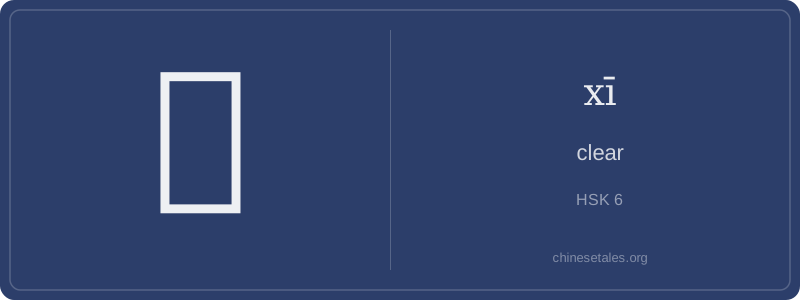
The earliest form of 晰 appears in seal script (c. 3rd century BCE), where it already combines 日 (sun) on the left with 析 (xī, ‘to split apart, dissect’) on the right. 析 itself evolved from a bronze inscription showing an axe (斤) chopping wood (木) — a powerful visual for analytical separation. In 晰, this ‘splitting’ wasn’t violent; it was illuminative. Sunlight doesn’t just shine — it *resolves*, revealing grain, edge, and boundary. Stroke by stroke, the modern form tightened: the sun radical became compact and centered, while 析 simplified — its axe (斤) now sits atop a clean, two-stroke 木 base, preserving the core idea of precise division under light.
This visual logic shaped its meaning across millennia. In the *Zuo Zhuan* (c. 4th century BCE), 晰 appears in contexts describing ‘clearly distinguishing friend from foe’ — not emotionally, but through rational, daylight-accurate perception. By the Tang dynasty, poets used 晰然 to evoke sudden enlightenment, like dawn dispelling illusion. Crucially, 晰 never meant ‘bright’ or ‘sunny’ on its own; its power lies in *relational precision* — the sun enabling discrimination, not just illumination. That’s why today, 晰 always implies an object being made distinct: a concept, a boundary, a logical step — never the light itself.
At its heart, 晰 (xī) isn’t just ‘clear’ in the way we say ‘the water is clear’ — it’s about *lucid precision*: sharp definition, unambiguous logic, and perceptual clarity so vivid it feels like sunlight hitting glass. Think of a high-resolution image, a flawlessly reasoned argument, or a memory recalled with photographic fidelity. Its radical 日 (rì, ‘sun’) anchors it in light — not warmth or time, but illumination that banishes haze. That’s why you’ll rarely see it describing physical transparency alone (like glass or water); instead, it modifies abstract nouns: 晰度 (xī dù, ‘clarity of definition’), 晰别 (xī bié, ‘precise differentiation’), or 晰然 (xī rán, ‘crystal-clear awareness’).
Grammatically, 晰 is almost never used alone as a predicate adjective — you won’t say ‘this is xī’. It’s overwhelmingly a *modifier*: it appears in compound words (e.g., 清晰, 明晰) or as the final morpheme in formal, written terms like 分析清晰 (fēn xī qīng xī, ‘analysis is clear’). Learners often mistakenly use it where 清 (qīng) or 明 (míng) would sound more natural — saying *‘这个解释很晰’* (a direct translation of ‘this explanation is very clear’) is unnatural; native speakers say *‘这个解释很清楚’* or *‘这个解释非常清晰’*. Notice how 晰 must be paired — it’s a team player, not a solo act.
Culturally, 晰 carries scholarly weight. It appears in classical phrases like 晰然可辨 (xī rán kě biàn, ‘distinctly discernible’) and modern academic writing to signal intellectual rigor. A common pitfall? Confusing it with similar-sounding characters like 惜 (xī, ‘to cherish’) or 希 (xī, ‘rare/hope’) — their tones and radicals differ, but the auditory overlap trips up beginners mid-sentence. Remember: when you need *laser-focused clarity*, think sunlight (日) cutting through fog — that’s 晰.