暧
Character Story & Explanation
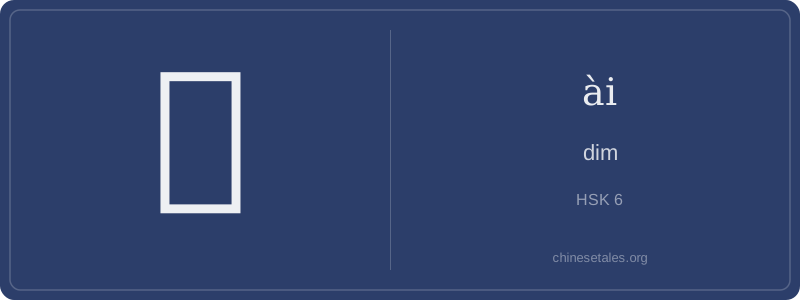
The earliest form of 暧 appears in seal script as a combination of 日 (rì, 'sun') on the left and 爱 (ài, 'to love') on the right — but crucially, the ancient 爱 included the heart radical 心, which was later simplified and lost. Visually, it was 日 + 愛 (with 心), suggesting 'sunlight infused with feeling' — not emotion per se, but light softened by atmosphere, as if the sun’s rays were gently embraced by mist. Over centuries, the complex 爱 shrunk: 心 vanished, 肉 (flesh radical) became 冖 (cover), then 冖 merged with 友-like strokes, yielding today’s simplified right side — still pronounced ài, but now visually unmoored from its emotional root.
This evolution mirrors its semantic journey: in the *Book of Songs* (Shījīng), 暧 described the tender, diffused light of early spring days — 'warm sun, veiled by thin clouds'. By the Tang dynasty, poets like Wang Wei used 暧日 (àirì) to evoke serene, golden afternoons. Its warmth was never thermal; it was optical — light muffled, boundaries softened. That visual softness became metaphorical: when human interactions lack clarity — like light obscured — they too became 暧昧. So the character didn’t change meaning; it expanded its domain from sky to soul, all while keeping its hushed, luminous core.
Think of 暧 (ài) as Chinese for 'mood lighting' — not the harsh glare of a fluorescent office, but that soft, hazy glow of late afternoon sun filtering through dusty curtains or fog clinging to city streets. It doesn’t mean 'dark' like 黑 (hēi), nor 'faint' like 微 (wēi); it’s specifically *indistinct luminosity* — light that’s present but blurred, warm but undefined, like the visual equivalent of a sigh. In English, we’d say 'dim', 'hazy', or 'dusky', but in Chinese, 暧 almost always appears in fixed literary compounds — never alone.
Grammatically, 暧 is strictly a bound morpheme: you’ll never see it solo in speech or writing. It only survives in elegant, often poetic phrases like 暧昧 (àimèi) or 暧日 (àirì). It never takes aspect particles (了, 过), never modifies nouns directly, and never functions as a verb or adjective on its own. Try saying *‘这个房间很暧’* — native speakers will blink and correct you: ‘很暧昧’? ‘很暖和’? No — ‘暧’ simply doesn’t work that way. It’s a fossilized syllable, preserved only in compound armor.
Culturally, 暧 carries quiet weight: its most famous descendant, 暧昧, has evolved from classical descriptions of atmospheric haziness into modern slang for emotionally ambiguous relationships — the 'neither-dating-nor-friends' limbo. Learners often misread it as ài (like 爱) and assume romantic meaning — but the character itself is neutral, even meteorological. Its danger lies in overextending it: using it outside set phrases makes your Chinese sound archaic or unintentionally poetic, like quoting Shakespeare at a coffee shop.