朴
Character Story & Explanation
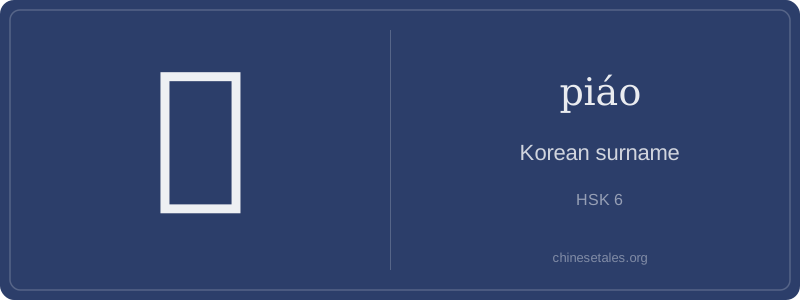
The earliest form of 朴 appears in bronze inscriptions as a combination of 木 (a stylized tree) and 卜 (a crack-like mark representing a diviner’s interpretation on turtle shell or bone). The wood wasn’t just any tree — it was freshly felled timber, still rough-barked and uncut, its grain unmasked by tools. Over time, the oracle bone ‘crack’ simplified into the modern 卜 shape, while 木 retained its trunk-and-branches structure. By the seal script era, the two components fused cleanly: six strokes total — four for 木 (the dot, horizontal, vertical, and捺), and two for 卜 (vertical and dot). No flourish, no frill — just the essence of material integrity.
This visual austerity mirrored its evolving meaning: from literal 'raw wood' in the *Book of Rites*, to metaphorical 'innate virtue' in Daoist thought — Laozi wrote, '见素抱朴,少私寡欲' ('See the plain, embrace the unhewn log; reduce self-interest, lessen desire'). The character became synonymous with authenticity untouched by artifice. Even today, when Chinese describe someone as 朴实无华, they’re invoking that ancient image: a person as solid and unpretentious as uncarved wood — and yes, that same wood is what gives Korean families like Piáo their ancestral name.
At its heart, 朴 is a character with split personality — and not in a confusing way, but in a beautifully layered one. Its core visual identity is rooted in wood (木), the radical you see on the left, while the right side (卜) looks like a divination crack or a simple mark — hinting at something unadorned, raw, and essential. In classical Chinese, 朴 (pronounced pǔ) meant 'unworked timber' — the tree before the carpenter’s chisel touched it — and thus came to symbolize natural simplicity, sincerity, and moral purity (think of Laozi’s 'return to the unhewn log'). That’s why you’ll see it in philosophical texts describing ideal human nature: 朴素 (pǔsù, 'plain and simple'), 朴实 (pǔshí, 'down-to-earth, sincere').
But here’s where learners trip: as a Korean surname, it flips to piáo — a pronunciation preserved from Middle Chinese Sino-Korean readings, *not* from modern Mandarin phonology. You’ll never say 'piáo' when reading 朴素; that would sound absurd. So grammatically, 朴 only appears as piáo *in proper nouns*, especially names like 朴槿惠 (Piáo Jǐnhuì). Outside names, it’s strictly pǔ (or rarely pò in archaic contexts like 朴树, a type of elm). Confusing the pronunciations isn’t just a tone error — it’s crossing linguistic borders.
Culturally, this duality reflects how Chinese characters absorb foreign usage without losing native meaning. Koreans adopted 朴 centuries ago for surnames, preserving an older sound, while Mandarin kept its philosophical weight. A common mistake? Writing 朴 as a generic 'simple' adjective in casual speech — but no, that’s always 朴素 or 朴实; standalone 朴 (pǔ) is almost exclusively literary or compound-bound. It’s a quiet character that carries immense semantic gravity — and wears two linguistic hats with perfect poise.