枕
Character Story & Explanation
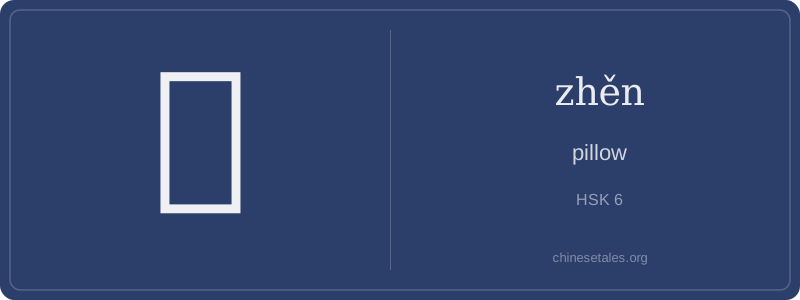
The earliest form of 枕 appears in bronze inscriptions around 900 BCE — not as a fluffy cushion, but as a rigid wooden headrest! Imagine a carved wooden block with a curved cradle for the neck: that’s what the ancient Chinese used before soft pillows became common. The character’s oracle bone precursor combined 木 (wood, radical) on the left with 沈 (shěn, an early phonetic component suggesting depth/sinking) on the right — visually echoing how the head *sinks* into support. Over centuries, 沈 simplified into 冘 (yín), then further stylized into the modern + 冖 + 又 shape — eight strokes total, each anchoring the idea of firm, grounded support.
This origin explains why 枕 feels sturdier than ‘pillow’: in the Book of Songs (c. 11th–7th c. BCE), 枕 describes ceremonial headrests used by nobles during rituals — objects of status, not softness. By the Tang dynasty, poets like Li Bai used 枕 metaphorically: ‘I lean my head on the moonlight’ (举头望明月,低头思故乡 — though not using 枕 directly, the imagery echoes its function). Even today, the wood radical reminds us: this isn’t just fabric and stuffing — it’s structural, ancestral, quietly essential.
At first glance, 枕 (zhěn) is just 'pillow' — soft, domestic, unassuming. But in Chinese thought, it’s a quiet anchor of intimacy and vulnerability: the place where you lay your head, literally and metaphorically. Unlike English ‘pillow’, which evokes fluff and comfort, 枕 carries subtle weight — it appears in classical poetry as a symbol of solitude (‘lying alone with my pillow’), longing (‘the pillow still holds her scent’), or even political exile (‘sleeping on a hard pillow far from court’). It’s never trivial.
Grammatically, 枕 is mostly a noun, but it can verbify elegantly: 枕着 (zhěn zhe) means ‘to rest one’s head on’, as in 枕着书睡着了 (zhěn zhe shū shuì zháo le) — ‘fell asleep resting my head on the book’. Learners often misplace tones (saying zhēn instead of zhěn) or overgeneralize — no, you don’t say *枕子 for ‘pillow’; it’s just 枕 or more commonly 枕头 (zhěn tou). Also, 枕 never stands alone in spoken Mandarin without context or modifier — it’s literary or poetic unless paired.
Culturally, the pillow isn’t just support — it’s a boundary object: between wakefulness and dreams, self and other, public duty and private rest. In Ming dynasty novels, characters ‘turn their pillow’ (翻枕) to signal emotional turmoil; in modern therapy-influenced writing, 枕边人 (zhěn biān rén) — ‘person beside the pillow’ — poetically means ‘spouse’ or ‘intimate partner’, carrying more tenderness than 配偶. Mistake this for a generic noun, and you’ll miss its quiet resonance.