柬
Character Story & Explanation
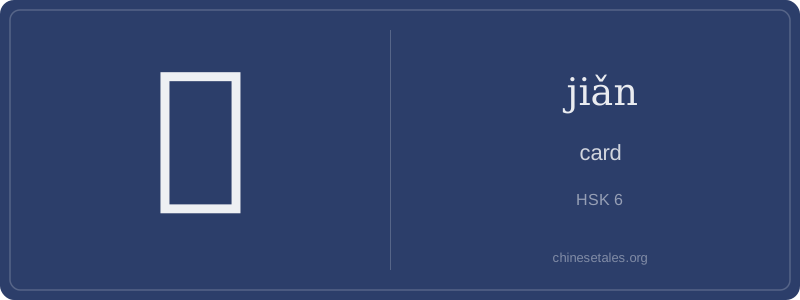
The earliest form of 柬 appears in seal script (around 3rd century BCE), where it clearly shows a hand (扌) holding a stylized wooden tablet — the left side 木 (wood) representing the material of ancient writing surfaces, and the right side 廾 (gǒng), an archaic hand gesture symbolizing careful handling or presentation. Over time, 廾 simplified into the top part that looks like two parallel strokes above a horizontal bar — a visual echo of hands offering something flat and significant. The 9 strokes aren’t arbitrary: 4 for the wood radical (left), 5 for the ‘presenting hands + surface’ component (right), mirroring the act of placing a document with reverence.
This physical origin directly shaped its meaning: in the Book of Rites (Lǐjì), 柬 described the ceremonial selection of auspicious days written on wooden slips — hence ‘selected writing’. By the Tang dynasty, it solidified as a term for formal, hand-copied announcements. Poets like Du Fu referenced 柬 in letters exchanged with officials, always stressing their crafted elegance. Even today, the shape whispers ‘wood + care’: no digital screen, no haste — just grain, ink, and intention.
At first glance, 柬 (jiǎn) feels like a quiet, elegant character — and it is! It doesn’t mean ‘card’ in the flimsy birthday-card sense, but rather a formal, handwritten note: think engraved wedding invitations, official appointment letters, or classical poetry manuscripts. Its core vibe is *intentional communication* — something carefully selected, refined, and dispatched with respect. That’s why you’ll rarely hear it in casual speech; it lives in formal writing, literary contexts, and bureaucratic documents.
Grammatically, 柬 functions almost exclusively as a noun (e.g., 请柬, 贺柬), never as a verb or adjective. Crucially, it’s never used alone — you won’t say ‘我写了一个柬’; instead, it appears only in compound nouns. Learners often mistakenly treat it like a free-standing word (like 卡), or confuse it with similar-looking characters like 简 (jiǎn, ‘simple’) — but 柬 has zero semantic connection to simplicity. Its tone (third tone) also trips people up: saying jiān or jiàn instantly shifts meaning to other characters entirely.
Culturally, 柬 carries weight: receiving a 请柬 isn’t just getting an invite — it’s being formally acknowledged within a social hierarchy. In imperial times, royal edicts sent to ministers were called 诏柬, underscoring its link to authority and precision. A common error? Using 柬 where 卡 or 信 would be natural in modern spoken Chinese — e.g., saying ‘生日柬’ instead of ‘生日卡’. Remember: 柬 = ritual, not routine.