株
Character Story & Explanation
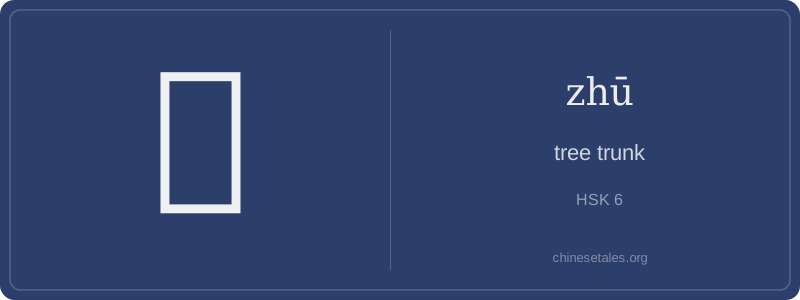
The earliest form of 株 appears in bronze inscriptions as a simple pictograph: a vertical line (the trunk) with two short horizontal strokes branching off near the top—like a stylized tree stem with stubby limbs. Over time, the top evolved into the ‘wood’ radical 木 (mù), anchoring its botanical identity, while the bottom simplified from a complex glyph representing ‘root + earth’ into the phonetic component 朱 (zhū), which also hints at the reddish bark of certain trees (like the cinnabar-red wood of the red sandalwood). By the seal script era, it had settled into its modern shape: 木 on the left, 朱 on the right—10 clean strokes balancing meaning and sound.
This visual logic shaped its meaning: not just any part of the tree, but the central, upright, countable unit—the trunk that stands firm and can be numbered, measured, or even seized as evidence. In the Mencius, 株 appears in agricultural contexts describing planted saplings; by the Tang legal codes, it was standard for tallying confiscated orchard stock. Even today, when officials report 'five hundred株 of rare orchids seized', they’re invoking that ancient precision: each 株 is a living, rooted individual—not a mass, not a species, but a counted entity with history and location.
At its heart, 株 (zhū) is the quiet, sturdy core of a tree—the trunk—where life rises from roots and branches out. It’s not just botanical: in Chinese, it carries weight, stability, and even legal or economic specificity. Think of it as the 'unit' of something rooted: one plant, one suspect in a criminal case (as in 案件的主犯), or one share in an old-style stock certificate. Unlike generic words like 树 (shù, 'tree'), 株 feels precise and countable—you say 一株花 (yī zhū huā, 'one plant of flower'), never *一棵花.
Grammatically, 株 is a measure word—but only for certain plants (especially shrubs, saplings, or ornamental trees), and it’s almost always paired with 一 (yī). You’ll see it in formal writing, botany texts, or legal documents (e.g., 查获涉案苗木三十二株 — '32 confiscated seedlings seized in the case'). Learners often mistakenly use it for large mature trees (use 棵 instead) or confuse it with abstract units like 个. Also, note: it’s never used alone—it always quantifies something living and rooted.
Culturally, 株 hints at China’s deep agrarian roots and meticulous record-keeping: counting individual plants mattered for taxation, land surveys, and forestry law since the Han dynasty. A common mistake? Using 株 for potted herbs or vegetables—those take 棵 or 根. And don’t forget its famous idiom 守株待兔 (shǒu zhū dài tù): 'waiting by the stump for rabbits'—a caution against passive hope. That stump? Literally a dead 株—making this character both literal and proverbial.