梢
Character Story & Explanation
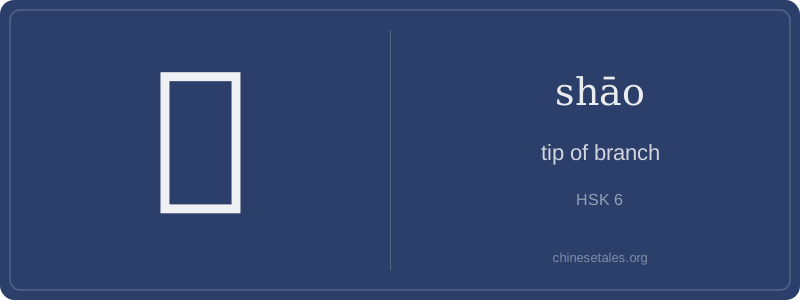
The earliest form of 梢 appears in Warring States bamboo slips as a pictograph combining 木 (tree) on the left and 肖 (xiāo, originally depicting a person’s head and spine, later semantic-phonetic) on the right. The 木 radical grounds it in botany, while 肖 — though now a phonetic component — once subtly suggested ‘diminutive form’ or ‘reduced shape’, perfectly capturing the idea of a branch’s slender, tapering extremity. Over time, the right side standardized into today’s 肖 (11 strokes total: 木 + 肖), losing its figurative human element but keeping its soft, descending contour — mirroring how a branch bends downward at its tip.
In classical texts like the Book of Songs, 梢 appears in phrases like ‘桑之未落,其叶沃若’ (before the mulberry leaves fall, lush they are), where later commentators noted that the vitality of leaves is most visible at the 梢 — the first place to catch light, last to wilt. By the Tang dynasty, poets like Wang Wei used 梢 metaphorically: ‘月出惊山鸟,时鸣春涧中’ — though 梢 isn’t named, the birds’ cries echo from treetops, making 梢 the silent stage for such moments. Its visual shape — tall, narrow, tapering — has always mirrored its meaning: the quiet, elevated climax of natural growth.
At its heart, 梢 (shāo) is not just 'tip of a branch' — it’s the Chinese eye for subtle, dynamic endpoints: where growth pauses, energy concentrates, and nature breathes out. Unlike English ‘tip’ (which can be sharp or abstract), 梢 carries quiet elegance and organic precision — think of a willow branch bending at its farthest, most flexible point, trembling in wind but never breaking. This isn’t an inert endpoint; it’s alive, vulnerable, poetic.
Grammatically, 梢 functions mainly as a noun (e.g., 树梢 shù shāo ‘treetop’) or in compound nouns, rarely alone. Crucially, it’s *not* used for human body parts (no ‘fingertip’ — that’s 指尖 zhǐ jiān) or mechanical ends (no ‘rocket tip’ — use 尖 or 端). Learners often overextend it, confusing it with 尖 (jiān, ‘sharp point’) or 端 (duān, ‘end/terminus’). Also, note: 梢 never appears as a verb or adjective — it’s a still, visual noun anchored in arboreal imagery.
Culturally, 梢 evokes classical landscape painting and poetry, where the ‘branch tip’ signals seasonal transition — a single plum blossom at the 梢 heralds spring’s arrival. Modern usage retains this delicacy: in literature, 梢 often marks emotional or narrative turning points (e.g., ‘hope flickering at the edge of despair’). Mistake it for 尾 (wěi, ‘tail/end’) and you’ll accidentally imply decay instead of poised potential — a tiny character, big tonal consequence.