榜
Character Story & Explanation
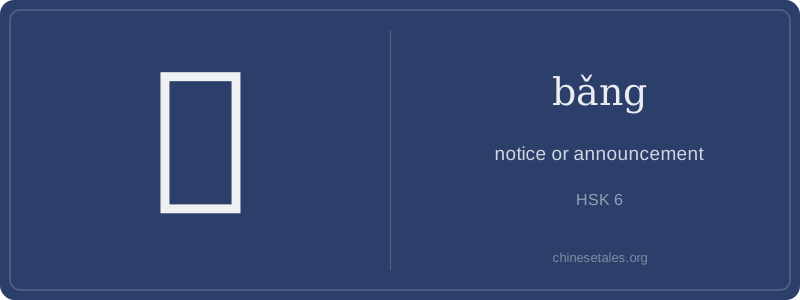
The earliest form of 榜 appears in Han dynasty clerical script, not oracle bone — because this character wasn’t ancient enough to be carved on turtle shells! It evolved from two key components: the left side 木 (mù, 'tree/wood'), representing the physical wooden board, and the right side 封 (fēng, 'seal' or 'to seal'), which originally depicted a hand placing a seal on a document — later stylized into the modern 又 + 寸 shape. Over centuries, the 'seal' component simplified and fused, while the wood radical stayed anchored on the left, grounding the character in its material reality: announcements weren’t abstract — they were literally nailed to timber.
This visual logic shaped its semantic journey: from 'wooden board bearing an official seal' → 'the sealed notice itself' → 'any ranked list issued by authority'. By the Tang dynasty, 榜 was standard in texts like the *Tang Liudian* (Institutions of the Tang), referring to examination lists. In *Dream of the Red Chamber*, Chapter 78 mentions '张榜招贤' (zhāng bǎng zhāo xián — 'posting notices to recruit talent'), showing how deeply tied it was to meritocratic ideals. Even today, when you see a university ‘放榜’, you’re witnessing a 1,300-year-old ritual — just with laminated paper instead of lacquered wood.
Think of 榜 (bǎng) as China’s original bulletin board — not digital, but wooden, public, and authoritative. Its core meaning is 'official notice' or 'public announcement', carrying weight and formality: you’ll see it on government postings, exam result lists, or rankings that matter. Unlike casual words like 告示 (gàoshì), 榜 implies institutional legitimacy — a notice nailed to a post, not scribbled on scrap paper. It’s almost always noun-based and rarely used alone; you’ll meet it in compounds like 榜单 or 发榜.
Grammatically, 榜 appears in set phrases, not free-standing verbs. You don’t 'bang' something — you *fā bǎng* (publish the list), *kàn bǎng* (check the notice), or *jìn bǎng* (make it onto the list). Learners often wrongly treat it as a verb ('to announce') or overuse it in informal speech — imagine texting '我刚发榜了!' for 'I just posted my lunch photo!' — nope! That’s a classic HSK-6 trap. Stick to contexts where stakes are high: exams, awards, official appointments.
Culturally, 榜 breathes with imperial history: during the Ming and Qing dynasties, the imperial examination results were literally pasted on wooden boards outside the Ministry of Rites — the *bǎng* was your ticket to power, prestige, and even marriage proposals. Today, it’s still evoked in headlines like '高考放榜' (gaokao fàng bǎng — 'college entrance exam results released'), keeping that solemn, ceremonial resonance alive. And yes — there *is* a rare alternate reading bàng (e.g., in the dialectal verb 榜人 'to row a boat'), but for 99% of modern usage? It’s bǎng — and it’s always about what’s posted, posted officially, and posted to be seen.