栏
Character Story & Explanation
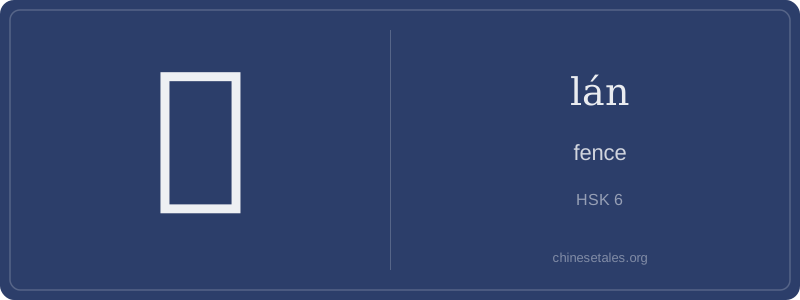
The earliest form of 栏 appears in bronze inscriptions as two vertical wooden posts (丨丨) with horizontal crossbars (一 or 二) between them — a clear pictograph of a simple wooden fence or railing. Over time, the left side standardized into the 木 (tree/wood) radical, anchoring its material essence, while the right side evolved from 兰 (a phonetic component, also meaning ‘orchid’ but here serving sound only) — not because fences smell floral, but because ancient scribes borrowed the shape for its pronunciation. By the Han dynasty, the nine-stroke form we know today was fixed: 木 on the left, 兰 on the right, with strokes flowing like interlocking timber joints.
This character’s semantic journey stayed remarkably faithful: from physical enclosures in Shuōwén Jiězì (121 CE) — ‘a fence made of wood’ — to metaphorical boundaries in literature. In Dream of the Red Chamber, characters lean on ornate 栏杆 while reflecting on social limits; in modern usage, it gracefully extends into abstract realms: the ‘information bar’ on a phone or the ‘comment section’ (评论栏) of an article — still a boundary, now digital and conceptual. The wood remains, even when invisible.
At its heart, 栏 (lán) is a quiet guardian — not of people or property, but of boundaries, order, and controlled access. Its core feeling isn’t aggression like ‘wall’ or ‘barrier’, but gentle demarcation: think the wooden railing along a staircase, the fence around a courtyard garden, or even the digital ‘menu bar’ on your screen (hence 栏目). Visually anchored by the 木 (wood) radical, it evokes craftsmanship and natural material — this isn’t concrete or steel, but something warm, hand-built, and permeable.
Grammatically, 栏 is almost always a noun, rarely used alone, and thrives in compound nouns. You’ll rarely say *‘a lán’* — instead, you’ll encounter 栏目 (lán mù, ‘column/section’), 栏杆 (lán gān, ‘railing’), or 专栏 (zhuān lán, ‘special column’). Crucially, it’s not a verb — you don’t ‘fence in’ with 栏; that’s 围 (wéi) or 圈 (quān). Learners often mistakenly try to use it transitively (*‘tā lán le yuánzi’*) — but that’s ungrammatical. Instead, say 他用栅栏围了院子 (tā yòng zhà lán wéi le yuàn zi).
Culturally, 栏 carries an air of refinement and structure: classical gardens feature exquisitely carved 栏杆; newspapers organize knowledge into 栏目; even modern apps segment content into navigation bars (导航栏). A common pitfall? Confusing it with 兰 (lán, ‘orchid’) — same sound, zero semantic overlap. Remember: 木 + 兰 = fence, not flower!