歧
Character Story & Explanation
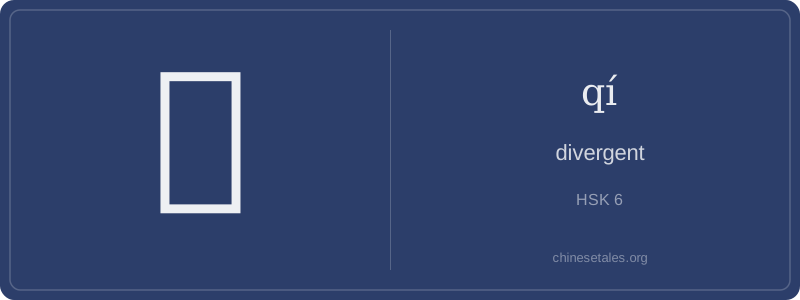
The earliest form of 歧 appears in bronze inscriptions as a compound: the radical 止 (zhǐ, 'to stop') on the left, and 支 (zhī, 'branch' or 'support') on the right — not as abstract strokes, but as a clear visual metaphor: a foot (止) standing at a junction where a path splits into branches (支). Over centuries, the oracle bone simplicity gave way to seal script stylization: 止 shrank slightly, 支 simplified its top to 十 (shí, 'ten') and retained its curved lower stroke, eventually crystallizing into today’s eight-stroke form — still unmistakably 'a stopping point where roads diverge'.
This spatial image quickly became conceptual: by the Warring States period, 歧 described not just crossroads but ideological forks — Mencius used 歧路 (qí lù) metaphorically to warn against moral confusion, comparing life to a traveler who, losing the main path, wanders down 'divergent roads' (《孟子·告子上》). The character’s enduring link between physical geography and abstract deviation made it indispensable for expressing intellectual, ethical, or linguistic divergence — a rare case where ancient cartography shaped philosophical vocabulary.
Think of 歧 (qí) as Chinese for 'fork in the road' — not just physically, but philosophically, socially, and linguistically. In English, we say 'divergent views' or 'a split in opinion'; in Chinese, 歧 carries that same sense of branching away, often with a subtle negative or cautionary weight — like noticing a deviation before it becomes a rift. It’s rarely used alone; you’ll almost always find it in compounds like 歧视 (qí shì, 'discrimination') or 歧义 (qí yì, 'ambiguity'), where it signals something has *departed* from neutrality, fairness, or clarity.
Grammatically, 歧 is strictly a noun or adjective root — never a verb. You won’t say '他歧了' ('he diverged'); instead, you use verbs like 产生 (chǎn shēng, 'to produce') or 出现 (chū xiàn, 'to appear') with 歧义 or 歧视. A classic learner trap: mistaking 歧 for a standalone action word, leading to unnatural phrasing. Also, while 'divergent' sounds neutral in English (e.g., 'divergent thinking'), 歧 in Chinese leans evaluative — 歧途 (qí tú, 'wrong path') implies moral or practical error, not creative exploration.
Culturally, 歧 echoes Confucian ideals of harmony and alignment — any 'branching off' risks disorder. That’s why 歧视 hits so hard: it’s not just 'prejudice', but a violation of social unity. Learners sometimes overuse it trying to sound literary, but native speakers reserve it for formal, critical contexts — you’d say 别人看法不同 for 'others have different opinions', not 别人看法有歧. The character’s power lies in its quiet gravity: one stroke away from 'stopping' (止), yet pointing insistently elsewhere.