殖
Character Story & Explanation
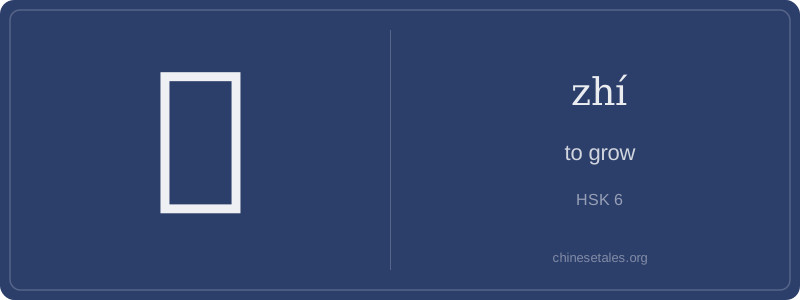
The earliest form of 殖 appears in late Warring States bamboo slips—not as a pictograph, but as a phonosemantic compound. Its left side 歹 (dǎi), the ‘death’ radical, originally depicted a fractured bone ( + 丶), symbolizing decay or mortality. The right side is 戠 (zhí), a now-obsolete character meaning ‘to gather’ or ‘to amass,’ composed of 戈 (weapon) and 聿 (writing brush), suggesting organized, purposeful accumulation. Over centuries, 戠 simplified into 直 (zhí, ‘straight’), creating today’s 殖—12 strokes, with the ‘death’ radical anchoring its serious, consequential tone.
This visual paradox—‘death’ + ‘straight/organized’—mirrors its semantic evolution. In classical texts like the *Guoyu*, 殖 first meant ‘to accumulate wealth or power’ (e.g., ‘殖货’—to amass goods), carrying connotations of expansion through disciplined effort. By the Han dynasty, it extended to biological propagation (‘殖种’—to sow seeds), and later, under Western linguistic influence in the late Qing, acquired its modern technical sense of ‘replication’—especially in colonial and biomedical contexts. The ‘death’ radical isn’t about dying; it’s a reminder that all propagation has limits, consequences, and ethical boundaries.
Imagine a biotech lab in Shanghai where scientists are carefully cultivating human stem cells—not just growing them, but *directing* their multiplication with precision. That’s 殖 (zhí) in action: not passive ‘growing’ like grass sprouting, but *intentional, controlled propagation*—of life, capital, or influence. It carries weight, agency, and often scale: you don’t ‘zhí’ a houseplant; you ‘zhí’ bacteria in a bioreactor, foreign investment in a special economic zone, or ideological influence across borders.
Grammatically, 殖 is almost never used alone—it lives in compounds and formal registers. You’ll see it as a verb in structures like ‘殖入’ (to implant/engraft), ‘殖发’ (to propagate hair follicles medically), or more commonly as part of nouns like ‘殖民’ (colonization) or ‘增殖’ (proliferation). Crucially, it’s *not* interchangeable with 生长 (shēngzhǎng) or 发展 (fāzhǎn)—those imply natural or organic growth; 殖 implies deliberate, often systemic, replication. Learners mistakenly use it for everyday ‘growth’ (e.g., ‘孩子在殖’), which sounds bizarrely clinical—like saying ‘the child is undergoing cellular proliferation.’
Culturally, 殖 echoes China’s modern reckoning with historical colonization and contemporary bioethics. Its presence in terms like ‘殖民主义’ (colonialism) carries visceral political gravity, while in medical contexts (e.g., ‘肿瘤细胞增殖’), it signals urgency and control. Because it’s HSK 6, it appears in academic, legal, and scientific discourse—not casual chat. Mastering 殖 means grasping not just vocabulary, but the Chinese conceptual distinction between organic growth and engineered replication.