殿
Character Story & Explanation
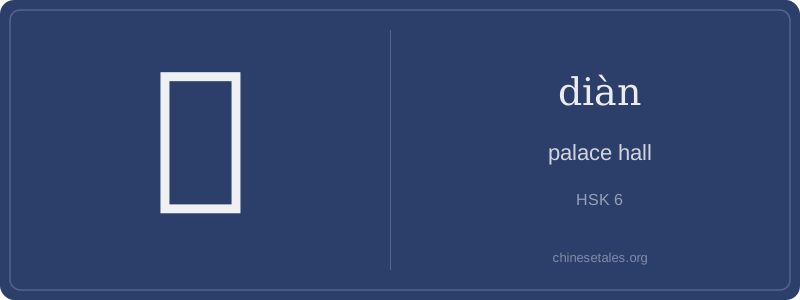
The earliest form of 殿 appears in bronze inscriptions as a pictograph combining two key elements: a roof (宀) over a raised platform (often with steps), and below it, the radical 殳 — a hand holding a weapon-like staff. This wasn’t about warfare, though: 殳 here symbolized authority and ritual enforcement. Over centuries, the roof simplified into 宀, the platform evolved into 共 (suggesting shared, solemn space), and the 殳 retained its shape at the bottom — 13 strokes total, each one anchoring dignity and order. By the Han dynasty, the character was standardized with its current structure: 宀 (roof) + 共 (shared ritual space) + 殳 (enforced authority).
This visual logic mirrors its semantic journey: from a fortified ceremonial platform in Zhou-dynasty ancestral temples, 殿 became the supreme hall of imperial palaces — the place where heaven’s mandate was affirmed. In the Book of Rites, 殿 is described as 'where the Son of Heaven receives the hundred officials,' cementing its link to legitimate power. Intriguingly, the same character later acquired the meaning 'to bring up the rear' — because in ancient military processions, the most honored commander stood at the front, while the elite guard unit (also called 殿) protected the rear, ensuring no retreat or disgrace. Thus, 殿 embodies both zenith and rearguard — the highest honor and the final, unwavering duty.
Think of 殿 (diàn) as China’s architectural equivalent of a cathedral nave — not just any room, but the grand, elevated, ritually charged central hall where power, ceremony, and divinity converge. In English, 'palace hall' sounds static, but in Chinese, 殿 carries weighty gravitas: it’s where emperors held audiences, where Buddhist sutras are chanted before golden statues, and where even modern institutions borrow its aura (e.g., 科学殿堂 — 'the hallowed hall of science'). It’s never used for ordinary rooms — you’d say 房间 for 'bedroom', not 殿.
Grammatically, 殿 is almost always a noun, typically appearing in compounds or after classifiers like 座 (a structure) or 大 (as in 大殿). You’ll rarely see it stand alone in speech, but it’s indispensable in formal writing and historical texts. Learners often misapply it in translations — saying *故宫的殿* instead of the correct 故宫的宫殿 (‘the palaces of the Forbidden City’) — because 殿 alone feels too bare; it needs context or a modifier to feel natural.
Culturally, 殿 implies hierarchy and reverence: the main hall is always 殿; side buildings are 堂 or 阁. A subtle trap? Pronouncing it as ‘diān’ (like 颠) — a tone error that could accidentally invoke ‘to topple’! Also, while 殿 can mean ‘to come last’ (as in 殿后), that usage is almost exclusively literary or military — don’t use it to say ‘I arrived last at dinner’ (use 最后 instead). That semantic duality — soaring height and humble rear position — is uniquely Chinese logic, rooted in classical battlefield formations.